

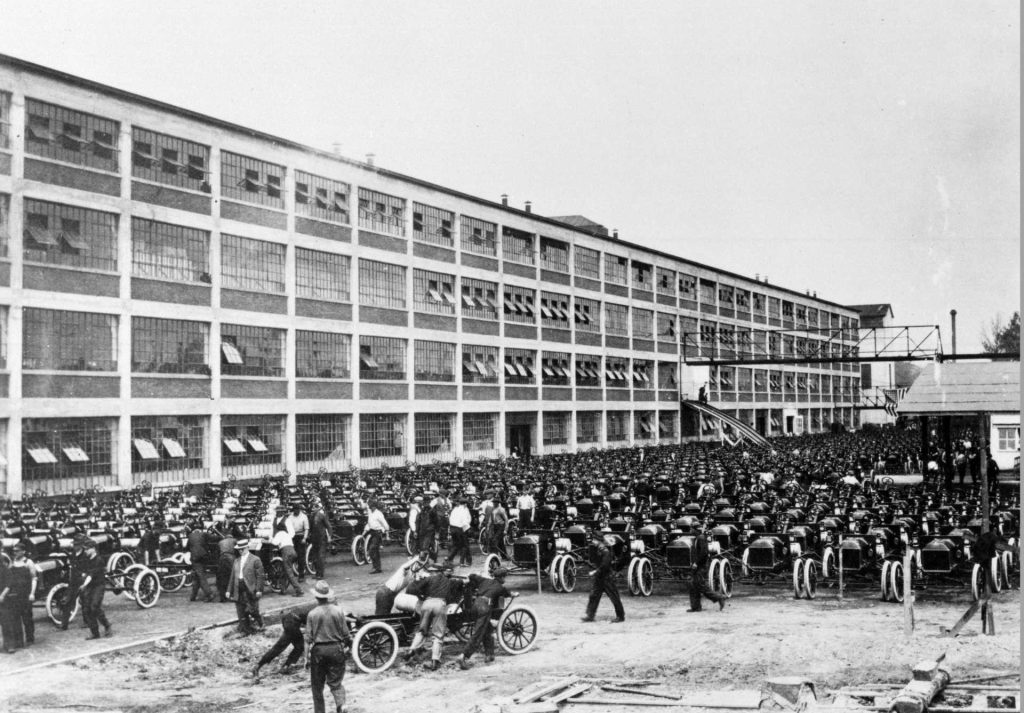
From shipbuilding and stove manufacturing to Henry Ford’s moving assembly line, Detroit became the world’s original proving ground for scalable manufacturing innovation. In the first of a three-part series, we explore how geography, industrial ambition and mass production transformed the city into the beating heart of modern manufacturing.
In March, Nineteen Group announced that it was taking its immensely popular Smart Manufacturing Week event across the Atlantic for the first time, selecting Detroit as the launchpad for its ambitious expansion into the North American market. The inaugural Smart Manufacturing Week US will be held April 19–22, 2027 at Huntington Place in Detroit, MI, with the exposition running April 21-22.
Detroit was selected as the host city because it sits at the heart of North American manufacturing. Industry estimates suggest that more than 3.3 million manufacturing jobs are located within a 250-mile radius of Detroit, highlighting the region’s enduring importance to North American industry.
But where does Detroit’s manufacturing legacy stem from, and how did the city become one of the most influential industrial powerhouses in modern history?
A city built by geography
Long before automobiles came to define Detroit’s global identity, the city’s location had already positioned it as a critical centre for trade and industry. Situated along the Detroit River — the narrow waterway connecting Lake Erie and Lake St Clair — the city occupied one of the most strategically important transport corridors in North America.
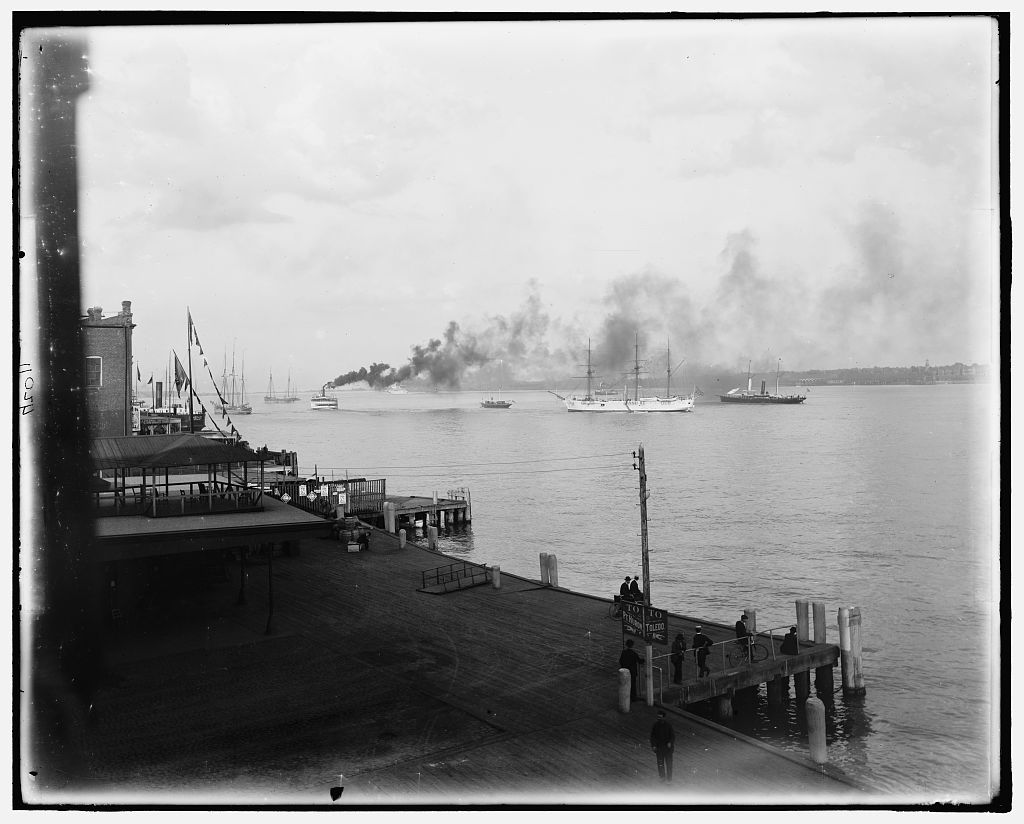
The Detroit River (pictured c. 1900) helped transform the city into a major industrial and trading hub, providing manufacturers with direct access to raw materials, shipping routes and the rapidly expanding markets of North America. Image credit: Library of Congress.
During the 18th and early 19th centuries, Detroit emerged as a key hub for the fur trade and shipping routes moving between the eastern United States, Canada and the expanding American frontier. As rail networks developed throughout the 1800s, the city’s importance only increased. Manufacturers could move raw materials into Detroit with relative ease while shipping finished products efficiently across the rapidly industrialising Midwest.
Its proximity to the Great Lakes also proved invaluable. Iron ore from Minnesota’s Mesabi Range, coal from Pennsylvania and timber from Michigan’s vast forests could all be transported cheaply via water. These resources would later become essential ingredients for heavy manufacturing.
By the mid-19th century, Detroit was no longer simply a trading post. It was evolving into a serious industrial city with foundries, shipbuilders, stove manufacturers and railcar companies establishing themselves across the region.
The city’s industrial future was already taking shape decades before the first automobile rolled off an assembly line.
The rise of industrial craftsmanship
Detroit’s transformation into a manufacturing powerhouse did not happen overnight. It was built upon generations of skilled tradespeople, engineers and entrepreneurs who established a culture of industrial craftsmanship long before the automotive boom.
Throughout the late 1800s, Detroit developed a strong reputation for precision manufacturing. Companies specialising in marine engines, cast iron stoves, rail equipment and carriage building flourished. The city became known for producing highly skilled machinists, toolmakers and metalworkers, expertise that would later become indispensable to the automotive industry.
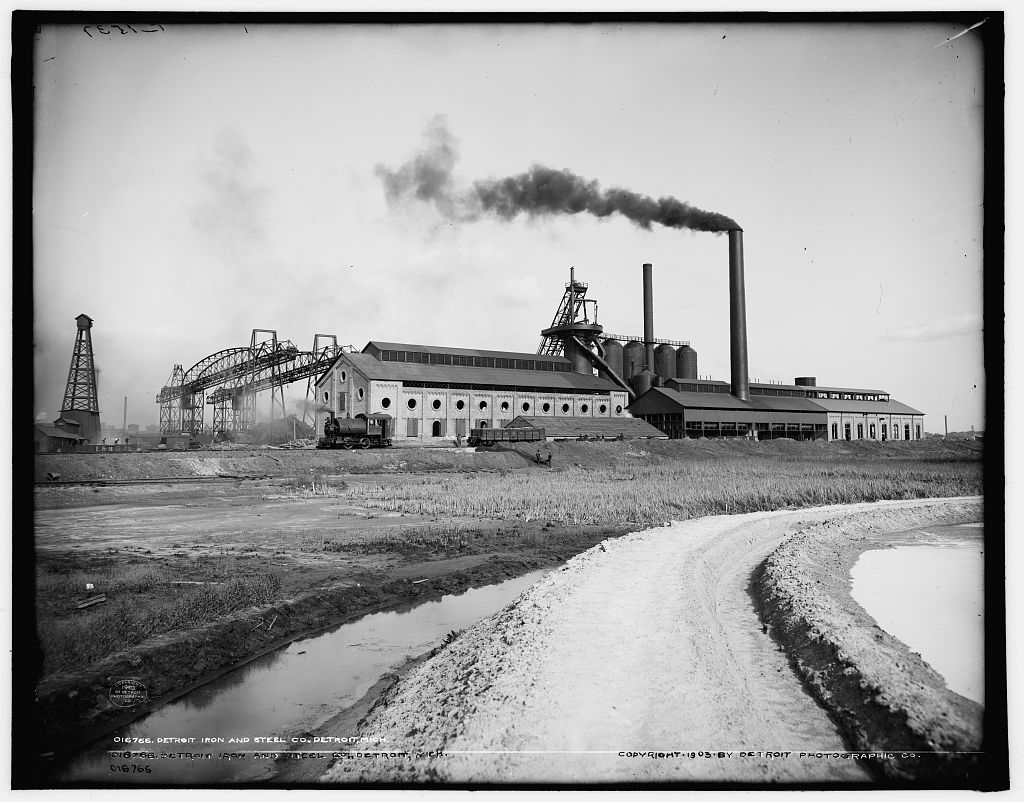
Companies such as Detroit Iron and Steel Co. helped lay the industrial foundations that would later enable Detroit’s rise as the world capital of mass manufacturing. Image credit: Library of Congress.
One of Detroit’s largest early industries was carriage manufacturing. By the 1890s, dozens of carriage and wagon companies operated across the city, supplying horse-drawn transport throughout the United States. Importantly, many of the techniques, supply chains and production methods used in carriage manufacturing would later transfer directly into automobile production.
The city’s machine shops also played a crucial role. These businesses developed increasingly sophisticated capabilities in metal fabrication and precision engineering at a time when industrial America was rapidly modernising. Detroit became home to a growing ecosystem of suppliers capable of producing gears, engines, tools, castings and industrial components.
This dense concentration of industrial capability created the ideal conditions for innovation. Entrepreneurs could source parts locally, collaborate with nearby suppliers and rapidly test new ideas. In many ways, Detroit was already functioning as an industrial cluster decades before the term existed.
From bicycles to automobiles
Like many industrial revolutions, Detroit’s automotive story emerged from unexpected beginnings.
During the 1890s, America experienced a massive bicycle boom. Bicycle manufacturing introduced lightweight metalworking techniques, precision bearings and new forms of mechanical engineering that would later influence automobile design. Several future automotive pioneers began their careers working with bicycles or related technologies.
At the same time, inventors across Europe and the United States were experimenting with self-propelled vehicles powered by steam, electricity and internal combustion engines. Detroit’s growing engineering expertise made it a natural environment for such experimentation.
Among the city’s early innovators was Ransom E. Olds, founder of Olds Motor Vehicle Company. Olds recognised that automobiles could become more than luxury curiosities for the wealthy. He began developing methods for producing vehicles more efficiently and consistently, introducing one of the earliest forms of assembly-line production at the turn of the century.
But it was another young engineer who would ultimately reshape not only Detroit, but manufacturing itself.
Henry Ford and the birth of mass production
When Henry Ford founded the Ford Motor Company in 1903, automobiles remained expensive products largely inaccessible to ordinary Americans. Vehicles were often built by hand in small quantities, making them costly and time-consuming to manufacture.
Ford’s vision was radically different. He believed cars should be affordable for the masses and understood that achieving this would require an entirely new approach to manufacturing.
In 1908, Ford introduced the Model T, a simple, durable and relatively affordable vehicle designed for widespread adoption. Demand quickly surged, but meeting that demand required unprecedented production efficiency.
The breakthrough came in 1913 at Ford’s Highland Park plant, where the company introduced the moving assembly line. Rather than workers moving between stationary vehicles, the vehicle itself moved through the factory while workers performed specialised tasks at fixed stations.
The results were revolutionary.
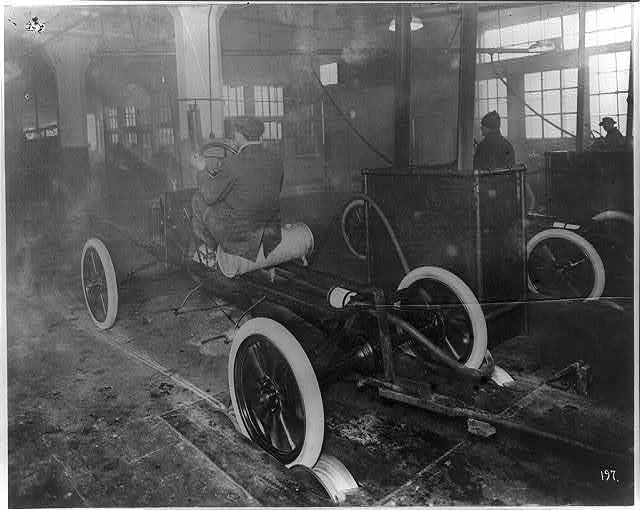
Model T’s coming off the assembly line at the Highland Park plant c. 1900. Image credit: Library of Congress.
Assembly times reportedly fell from more than 12 hours to around 90 minutes. Costs dropped dramatically while production volumes soared. The Model T became one of the first truly mass-produced consumer products in history.
More importantly, Detroit proved that manufacturing innovation was not simply about inventing products, it was about inventing systems capable of producing at enormous scale with speed, consistency and affordability. That principle would go on to define modern industrial production.
Ford’s manufacturing innovations fundamentally changed industrial production worldwide. Factories across countless industries soon adopted assembly-line principles, standardised parts and workflow optimization strategies inspired by Detroit’s automotive plants.
The city rapidly became synonymous with industrial scale.
The ecosystem effect
While Henry Ford remains the most recognisable figure in Detroit’s industrial history, the city’s manufacturing dominance was never the result of one company alone.
Detroit succeeded because it developed an interconnected industrial ecosystem.
As automotive production expanded during the early 20th century, hundreds of suppliers, machine shops, steel processors, toolmakers and component manufacturers clustered around major automakers such as Ford, General Motors and Chrysler. This concentration created powerful network effects.
Suppliers benefited from proximity to customers. Manufacturers could rapidly collaborate with engineering partners. Skilled workers migrated to the city in huge numbers, attracted by employment opportunities and relatively high industrial wages.
Innovation accelerated as companies competed and shared expertise within the same geographic region.
In effect, Detroit became an early blueprint for the modern industrial ecosystem, where suppliers, manufacturers, logistics networks and engineering expertise operated in close proximity to accelerate innovation and scale production rapidly.
The growth was extraordinary. Between 1900 and 1930, Detroit’s population exploded from roughly 285,000 to more than 1.5 million people. Immigrants and workers from across the United States arrived seeking opportunity in the booming automotive sector.
Factories expanded relentlessly across the city skyline. Massive industrial complexes emerged alongside railroads and waterways. Detroit became a symbol of industrial modernity, a city powered by steel, machinery and mass production.
The Arsenal of Democracy
Although Detroit’s identity became deeply tied to automobiles, the city’s manufacturing infrastructure would prove even more important during times of national crisis.
During the First and Second World Wars, Detroit’s factories were rapidly retooled to support military production on an enormous scale. Automotive plants that once produced civilian vehicles began manufacturing tanks, aircraft engines, military trucks and weapons.
The scale of wartime production during World War II earned Detroit the nickname “The Arsenal of Democracy”.
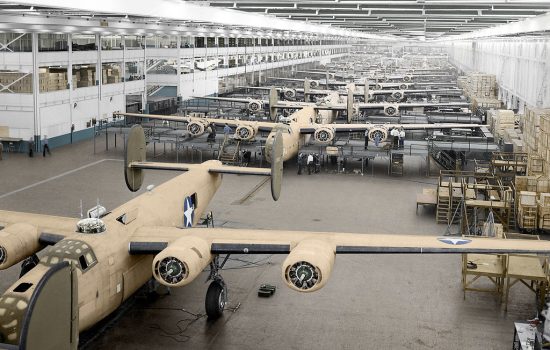
Factories operated around the clock. Ford’s Willow Run plant famously produced B-24 Liberator bombers at unprecedented rates, while manufacturers across the region supplied critical wartime equipment to Allied forces.
Detroit’s ability to pivot industrial production at such scale demonstrated the immense flexibility and capability of its manufacturing base. The city had become more than an automotive centre, it was the industrial engine of the United States.
This period also reinforced Detroit’s global reputation for manufacturing excellence. The systems, supply chains and engineering capabilities developed during wartime would continue shaping industrial production for decades afterwards.

Manufacturing creates the middle class
Detroit’s rise was not solely an industrial story; it was also a social and economic transformation.
Manufacturing jobs offered wages and stability that helped create America’s industrial middle class. Ford’s famous introduction of the five-dollar workday in 1914 shocked industrial America and helped establish new expectations around factory wages.
Well-paid manufacturing jobs enabled workers to buy homes, raise families and participate in the expanding consumer economy. Entire communities across Detroit and the wider Midwest were built around industrial employment.
The city became a powerful symbol of economic mobility. For many immigrant families and workers migrating from the American South, Detroit represented opportunity and upward progression through industrial work.
At the same time, rapid industrialization also created significant social challenges. Labour disputes, dangerous working conditions and racial tensions emerged alongside economic growth. Detroit’s factories became central battlegrounds for labour organization throughout the 20th century, with unions such as the United Auto Workers playing a major role in shaping American labour rights.
These tensions would later influence both the city’s successes and its struggles.
The industrial blueprint for the modern world
By the 1920s, Detroit had firmly established itself as the global centre of automotive manufacturing and one of the most influential industrial cities on earth.
But Detroit’s legacy extended far beyond cars.
The city helped define many of the manufacturing principles that still underpin industrial production today: assembly lines, standardized components, vertically integrated supply chains, high-volume production systems and industrial specialization.
Modern manufacturing hubs across the world — from Germany’s automotive clusters to advanced industrial regions in Asia — still reflect concepts pioneered in Detroit more than a century ago.
Even today, many of the challenges and opportunities facing manufacturers can be traced back to lessons first learned in Detroit’s factories: how to scale production efficiently, integrate supply chains, develop skilled workforces and continuously improve industrial processes.
Detroit became the original proving ground for scalable manufacturing systems, a living laboratory for industrialization whose influence still stretches across modern factories today.
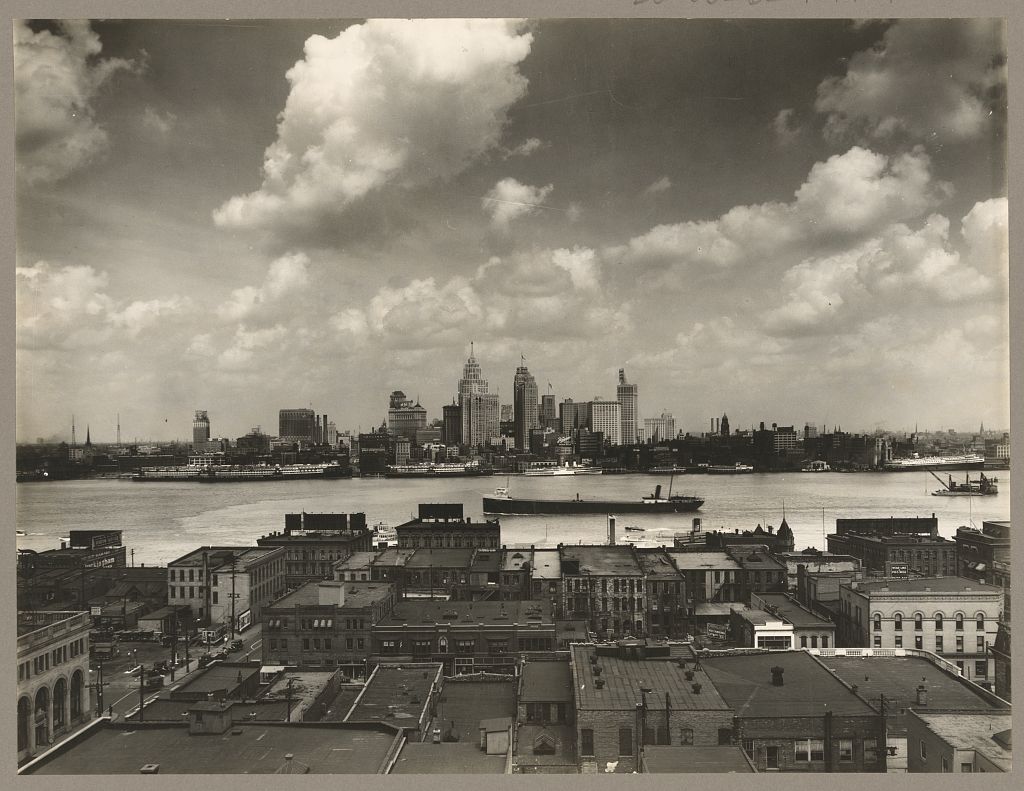
Detroit’s vast industrial complexes became symbols of mass production and manufacturing scale during the early 20th century. Pictured: The Detroit skyline and boats on the Detroit River as seen from Windsor, Ontario c. 1929. Image credit: Library of Congress.
A legacy still shaping manufacturing today
Detroit’s manufacturing story is often framed through the lens of decline — factory closures, deindustrialization and economic hardship. Yet that narrative only tells part of the story.
The city remains deeply connected to manufacturing innovation. Advanced automotive engineering, robotics, electrification, mobility technologies and industrial automation continue to shape the region’s economy. Global manufacturers, suppliers and technology companies still maintain major operations across Detroit and the wider Midwest.
More importantly, the city’s industrial DNA continues influencing manufacturing culture around the world.
The same principles that defined Detroit during the early 20th century — production efficiency, workflow optimization, supply chain integration and scalable industrial systems — now sit at the heart of smart manufacturing, AI-driven production and the factories of the future.
As manufacturers navigate AI adoption, reshoring, supply chain disruption and industrial decarbonization, many of the core questions remain surprisingly familiar: how to produce more efficiently, scale new technologies and build resilient industrial ecosystems.
Detroit has faced those questions before.
And perhaps that is precisely why the city remains such a fitting home for the next chapter of industrial innovation.
In the next instalment of this series, we will explore Detroit’s rise to industrial supremacy during the mid-20th century, from the wartime mobilization of the ‘Arsenal of Democracy’ to the global dominance of the Big Three automakers, and examine how shifts in competition, technology and consumer demand eventually exposed the vulnerabilities of even the world’s mightiest manufacturing powerhouse.
Never miss a North American manufacturing story
Sign up for our free weekly North American Manufacturing Digital Briefing to receive the latest industry news, insights and analysis direct to your inbox every Monday.