

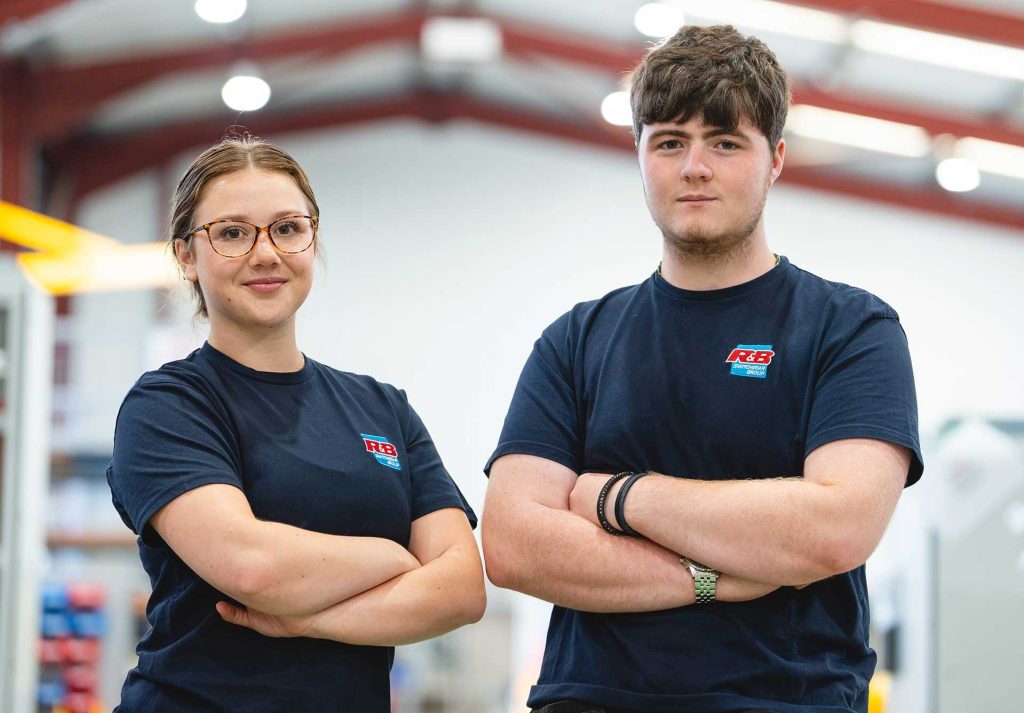
This week (w/c 13 October) is National T Levels Week and at a time when the industry’s longstanding skills gap is costing the UK economy £6bn in lost output each year, could T Level industry placements be the key to unlocking new manufacturing talent?
We hear from manufacturing firms, R&B Switchgear Group and Redpack Packaging Machinery, who gave permanent roles to twelve T Level students after successfully completing their industry placements.
What are T Levels?
T Levels are a two-year technical qualification for 16–19-year-olds, designed in partnership with employers to address skills gaps within the engineering and manufacturing industry.
Each T Level includes a 45-day industry placement where students spend time with an employer. Placements are flexible and built around employers’ needs. Employers can test – and shape – students’ skills to see if they’re a good fit.
One in three T Level students who progress into work are hired by their placement employer (DfE). The skills students bring with them are helpful across the industry – from producing drawings and using CAD software to quality control, fault finding and risk assessment.
Investing in talent
R&B Switchgear Group, a Manchester-based manufacturer and power engineering specialist, is investing in the next generation of technical talent to meet growing demand across its operations.
Employing around 100 people across the UK, the company delivers bespoke electrical systems to clients across the marine, oil & gas, transport, healthcare, and energy sectors.
R&B Switchgear Group has expanded rapidly in recent years, opening new facilities across the UK and overseas. As the business grew, the leadership team identified a widening skills gap. Technical & Training Manager, Gavin Chadwick, explains: “With a high proportion of our skilled workforce nearing retirement and a limited external talent pool in such a specialist field, it became clear that we needed a strategy to develop our own talent from within.”
In response, the company partnered with three local colleges and, in 2023, welcomed its first cohort of six Engineering and Manufacturing T Level students, followed by another six the following year.
One of the main attractions of T Levels was the chance to bring in students already equipped with strong technical foundations and the confidence to apply their skills from day one. During their placement at R&B Switchgear, the students worked on a range of tasks, including mechanical fitting (measuring, marking out, drilling, tapping), electrical fitting (crimping, wiring looms, basic electrical schematic drawings) and CAD.
“The T Level students have been a breath of fresh air,” says Gavin. “They’re keen, enthusiastic and bright. It’s really boosted the business, and the people within the existing team as well.”
Impressed by the T Level students’ efficiency and enthusiasm, R&B offered five of them full-time apprenticeships upon completing their course. The initiative has strengthened R&B’s recruitment pipeline, and the company plans to continue offering industry placements for years to come. Gavin concludes: “To other employers I would say take on T Level students – they’re the future of your business.”
The right technical skills
Redpack Packaging Machinery, based in Norfolk, employs around 80 people and manufactures high-performance flow wrap machines used to package products such as food, cosmetics, and toys.
General Manager Gary Howard says: “We were approached by the local technical college to take on some T Level students two years ago and I’m so pleased we said yes. We hosted two students last year and two this year, and they’ve all been a brilliant asset to the business.”
Gary says the students’ enthusiasm and technical ability stood out: “Because they’re studying for a technical qualification, they have the technical knowledge needed for a meaningful placement, which work experience students don’t always have.”
Redpack gives students a 360-degree experience of the business, rotating them through the electrical section and design area, to fitting, assembly, and testing. “They start being productive quite quickly, which is obviously brilliant for the business,” says Gary. “We’ve also found it’s been beneficial for our employees’ professional development; by buddying with or mentoring the T Level student, they can develop their own leadership skills.”
The 315-hour placements, he says, go by in no time: “By giving the students experience of all the different parts of the business, the 45 days just flew by. We were well supported by the local technical college where the students are studying, so I really think T Levels are a game-changer.”
Redpack has since offered apprenticeships to seven of its T Level students, creating a reliable recruitment pathway, where both sides know what to expect.
Gary says: “Some of us are stuck in our old ways, having worked in the manufacturing industry all our lives. One of the best things about T Level students is that they come in with fresh eyes and say: ‘Why can’t we try this?’. It’s refreshing and a good challenge for us.”
For both Redpack and R&B, hosting T Level students has been a huge success. Gary concludes: “They’re adding value to our business and they’re doing real work, just like any other employee would be doing here. I would 100% recommend T Levels for any employer – it’s a simple process and they’re very productive.”
Find out more about T Level industry placements by visiting the T Level website.
For more articles like this, visit our People & Skills channel.