

A new report has warned that while the UK possesses world-leading strengths in manufacturing and artificial intelligence (AI), many manufacturers remain stuck in the experimentation phase and are struggling to deploy the technology at scale.
The report, From Pilot to Production: A Practical UK Plan to Scale Industrial AI Deployment in Advanced Manufacturing, authored by Professor Chris Dungey, HVM Catapult Chief Technology Officer and the government’s AI Champion for Advanced Manufacturing, highlights a growing gap between the UK’s AI capabilities and its ability to translate them into widespread industrial adoption.
According to the report, manufacturing contributes around £234bn annually to the UK economy, supports 2.5 million jobs and accounts for nearly half of private sector research and development investment. AI has the potential to improve productivity, quality, resilience and energy efficiency, while supporting predictive maintenance, supply chain optimisation and safer factory operations.
However, despite the rapid advancement of AI technologies, adoption across UK manufacturing remains “uneven and slow”, particularly in operational technology environments where many of the highest-value applications exist.
The report argues that too many businesses are failing to move beyond proof-of-concept projects, creating a risk that the UK could lose ground to international competitors including Germany, the United States, Japan and China, which are increasingly focused on industrial AI deployment at scale.
“This is not about inventing new AI, but rather scaling existing, world-class solutions across the economy. While AI capability is advancing rapidly, adoption across UK manufacturing remains uneven and slow. We need a clear national pathway to connect innovation, workforce capability and deployment at scale.
“If the UK moves too slowly, it risks weaker productivity growth, slower uptake among SMEs and supply chains and falling behind countries already turning AI capability into industrial advantage. This investment will help businesses across the UK build the understanding and confidence to adopt these revolutionary technologies.”
– Professor Chris Dungey
SMEs face significant barriers
A key finding is that many manufacturers, particularly small and medium-sized enterprises (SMEs), continue to face substantial obstacles when attempting to implement AI.
Among the most common challenges identified are legacy production systems, fragmented industrial data, uncertainty over return on investment, limited access to test environments, workforce capability gaps and concerns around integration, safety and operational risk.
These factors have contributed to what the report describes as a “pilot trap”, where promising AI projects fail to progress into long-term operational deployments.
Unlike many office-based AI applications, industrial AI must operate reliably in complex, safety-critical environments alongside machinery, production processes and workers. As a result, manufacturers require greater evidence of value and performance before committing to wider deployment.
Call for a national adoption pathway
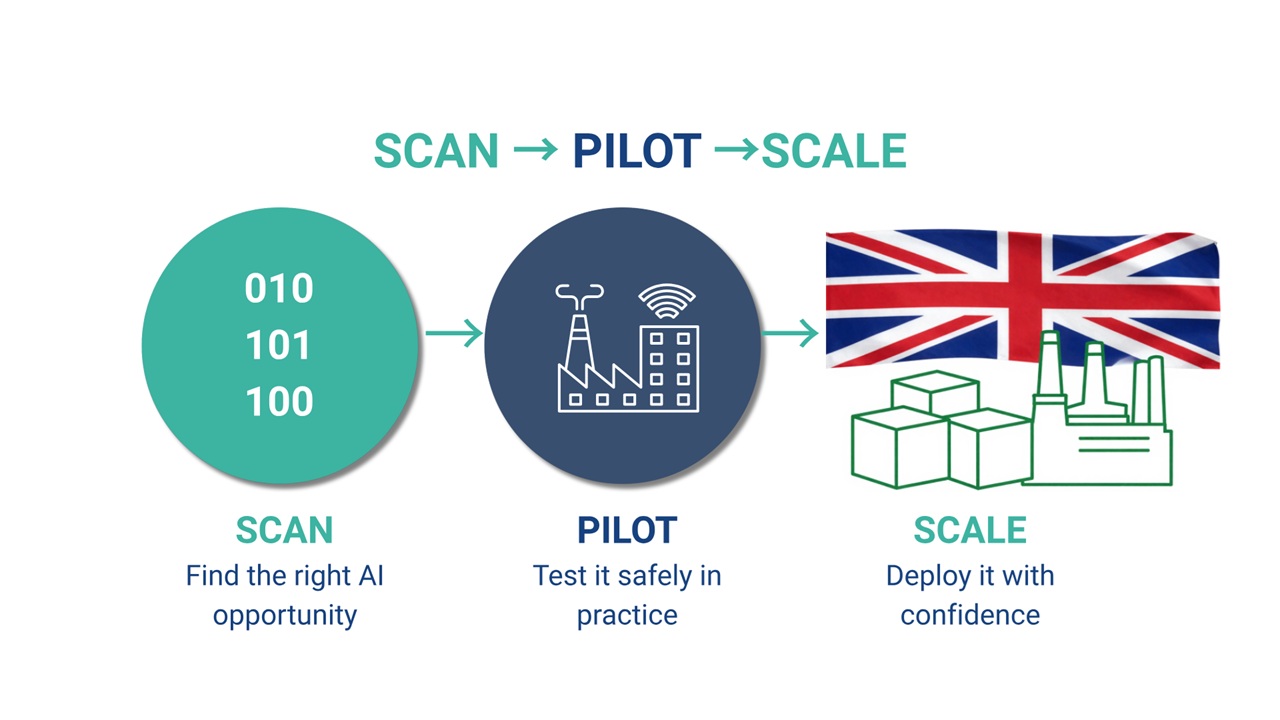
Image credit: Department for Science, Innovation & Technology.
To accelerate adoption, the report proposes a national “Scan-Pilot-Scale” framework designed to help manufacturers move from initial exploration through to large-scale implementation.
The model would build on existing programmes and organisations, including Made Smarter, Innovate UK, BridgeAI, Make UK and the High Value Manufacturing Catapult, rather than creating new institutions.
Under the proposal, manufacturers would first assess opportunities and readiness through a national AI support gateway before accessing regional testbeds and pilot programmes to trial solutions in realistic operating environments. Successful projects would then be supported through wider deployment across factories and supply chains.
The report also recommends five priority interventions: a national AI front door, workforce capability programmes, industrial AI validation and trusted data environments, SME-focused fast-track adoption schemes, and a network of AI lighthouse manufacturing sites demonstrating large-scale deployment in live production settings.
Skills and workforce confidence critical
Alongside technology investment, the report emphasises the importance of workforce engagement and skills development.
Dungey argues that successful AI adoption depends as much on people as technology, calling for a “pro-worker” approach that focuses on improving safety, reducing routine tasks and helping employees work more effectively alongside AI systems.
The report advocates better coordination of existing initiatives, including apprenticeship programmes, AI skills training and support available through organisations such as the High Value Manufacturing Catapult and Innovate UK’s BridgeAI programme.
Competitiveness challenge
The report concludes that industrial AI adoption has become a competitiveness issue for UK manufacturing.
While the UK possesses advanced manufacturing expertise, strong regional innovation networks and globally recognised AI research capabilities, Dungey argues that these strengths must now be converted into practical deployment across factories and supply chains.
“Industrial AI can raise productivity, strengthen resilience, improve quality and cut energy use,” the report notes. “This plan is not about inventing new AI. It is about helping British manufacturers use proven AI at scale.”
Without faster adoption, the report warns, UK manufacturers risk weaker productivity growth and falling behind competitors that are already translating AI innovation into industrial advantage.
Stakeholder reaction
 Brian Holliday, CEO of Siemens in the UK and Ireland, said: “The Government’s AI adoption plan is a welcome signal of intent. Technology adoption is vital to tackling the UK’s productivity slump. AI now raises the stakes – we can join the pack or risk being left behind.
“The OECD suggested in 2025 that AI could lift UK productivity growth by 0.4 to 1.3 percentage points in the next 10 years. And, from our work with customers, we know that autonomous AI agents could drive productivity gains of up to 50 per cent in some cases.
“I particularly welcome the focus on workforce capability given Skills England’s annual report released last week highlighted the need to define and embed core AI skills into the workforce to adopt new technologies. If we align policy, technology and skills, businesses on the ground can benefit from AI as a powerful engine for growth.”
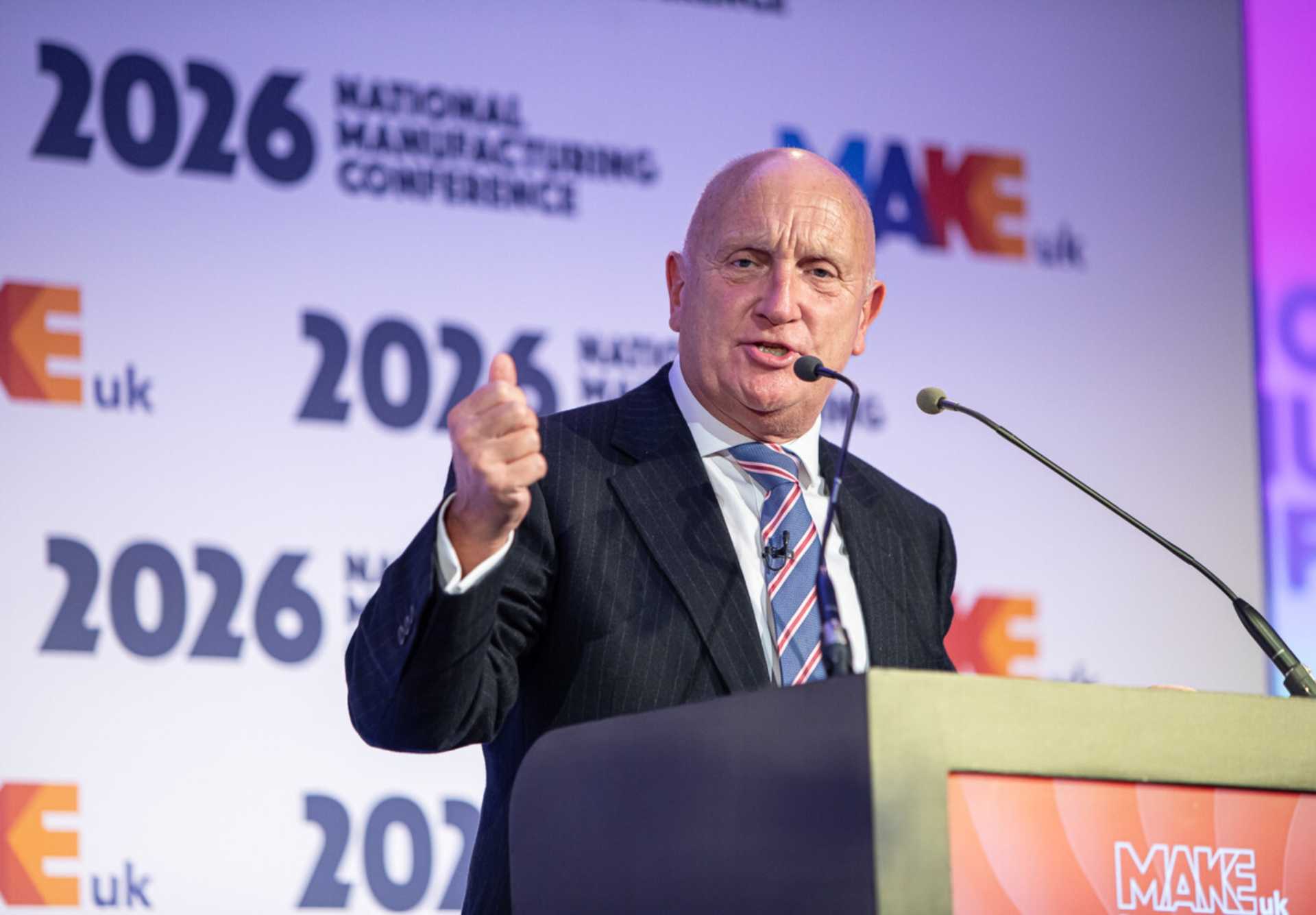 Stephen Phipson, CEO of Make UK, said: “AI offers manufacturers huge potential to unlock significant gains and a boost to overall growth by utilising specific areas such as energy efficiency and skills. But, until now what has been missing has been a firm plan to mobilise this potential. The AI Adoption Plan for Advanced Manufacturing is the missing piece of the jigsaw and is a welcome and, positive, step by Government which will help manufacturers scale up and grow.”
For more articles like this, visit our Data & AI channel