
UK vehicle manufacturing output declined sharply in February, underscoring mounting pressure on the sector from weak global demand, export volatility and ongoing industrial disruption, according to the latest data from the Society of Motor Manufacturers and Traders (SMMT).
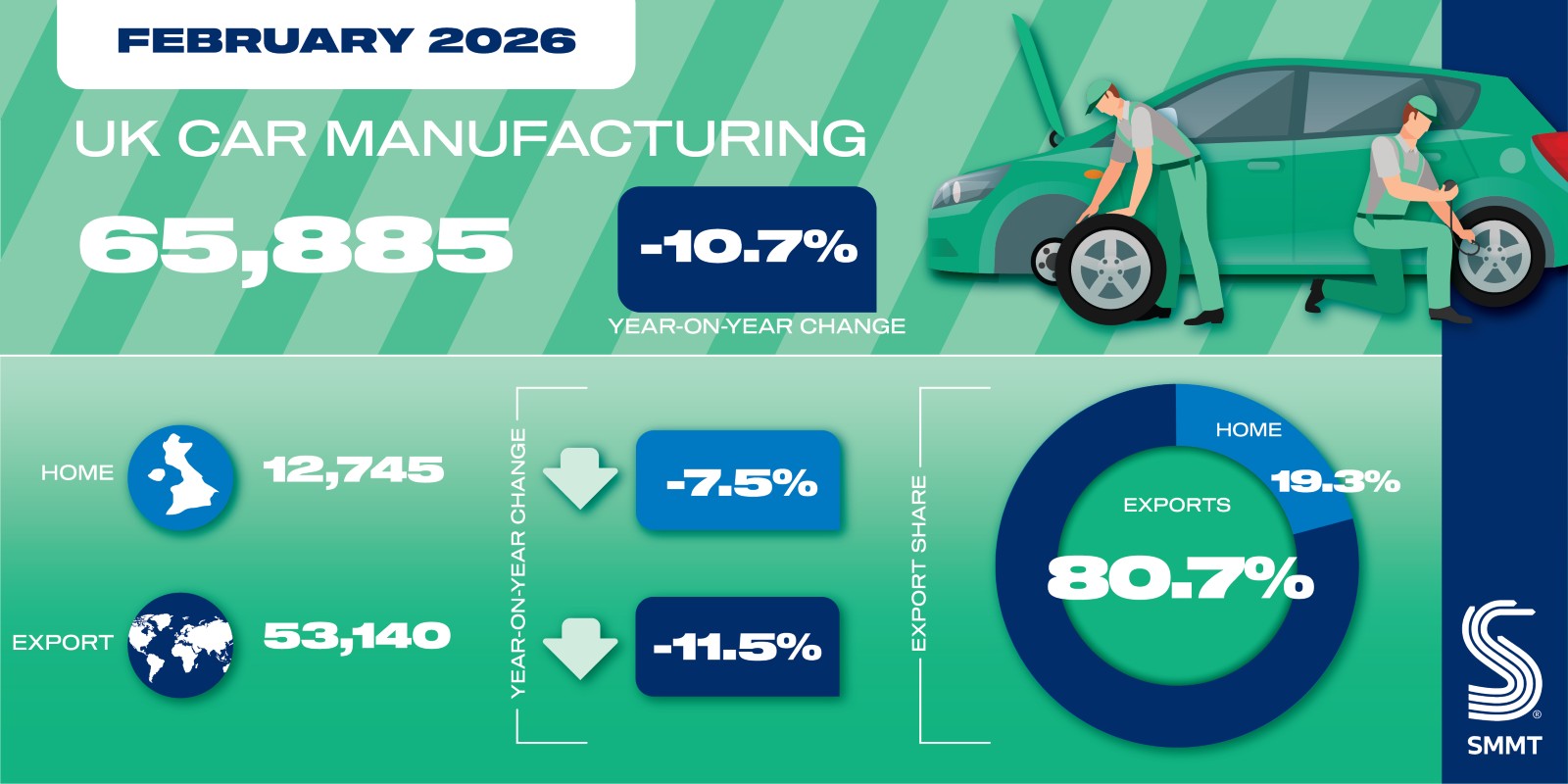
Total production fell by 17.2% year-on-year to 68,061 units, with declines recorded across both passenger cars and commercial vehicles (CVs). Car output dropped 10.7% to 65,885 units, while CV production saw a far steeper contraction, plunging 74.0% to just 2,176 units amid continued restructuring at a major plant.
Export weakness hits production volumes
The latest figures highlight the UK automotive sector’s continued reliance on overseas markets, and its vulnerability when global demand softens.
Exports accounted for 80% of total vehicle output, but shipments fell significantly. Car exports declined 11.5% to 53,140 units, while CV exports dropped 65.1% to 1,306 units. Although the EU remained the dominant destination, absorbing 63.6% of car exports and 88.9% of CV shipments, growth in European demand was not enough to offset steep declines elsewhere.
Exports to the US fell by 34.3%, while shipments to China and Japan dropped by 66.4% and 6.8% respectively, reflecting broader weakness in key global automotive markets.
Domestic demand also under pressure
The downturn was not limited to exports. Production for the UK market also contracted, with car output for domestic buyers falling 7.5% to 12,745 units. CV production for the home market dropped even more sharply, down 81.2% to just 870 units.
Despite the overall decline, electrified vehicle production showed relative resilience. Output of battery electric (BEV), plug-in hybrid (PHEV) and hybrid (HEV) vehicles fell only 2.8% to 26,629 units, increasing their share of total car production to 40.4%. This suggests structural momentum in the transition to electrification, even as overall volumes weaken.
Manufacturing disruption and policy risks
Beyond demand-side pressures, production volumes were also impacted by model changeovers and ongoing industrial restructuring, particularly in the commercial vehicle segment.
At the same time, the sector faces increasing geopolitical and regulatory uncertainty. Fresh instability in the Middle East is expected to add further strain to supply chains, while proposed EU policy changes could introduce additional barriers to trade.
The European Commission’s planned Industrial Accelerator Act includes “Made in the EU” provisions that, as currently drafted, risk disadvantaging UK-built vehicles and components. Industry leaders warn this could undermine a trading relationship worth nearly £70bn annually and potentially conflict with the terms of the EU–UK Trade and Cooperation Agreement.
Industry calls for coordinated action
SMMT Chief Executive Mike Hawes warned that the latest figures are particularly concerning given they precede the latest geopolitical escalation.
“Another decline for UK vehicle production and exports is extremely worrying, given these figures pre-date the crisis in the Middle East.
“While the sector has made efforts to build resilience into its logistics and supply chains post Covid, the conflict adds further strain.
“Now more than ever we must focus on our industrial competitiveness by driving down energy costs, backing our suppliers, supporting our domestic market and securing free and fair trade with Europe.”
– Mike Hawes, SMMT Chief Executive.
Outlook: mounting headwinds for UK manufacturing
The February figures reinforce a challenging outlook for UK automotive manufacturing. With global demand subdued, exports under pressure and policy uncertainty growing, manufacturers face a complex mix of cyclical and structural challenges.
While the increasing share of electrified vehicle production offers a longer-term growth pathway, near-term recovery will likely depend on stabilising global markets, easing geopolitical tensions and maintaining open, competitive trade relationships, particularly with Europe, the UK sector’s most critical export destination.
For more articles like this, visit our Leadership channel