

Energy volatility, not just energy price, is what breaks manufacturing budgets. On-site solar can reduce the uncertainty and turn the unknown into a lower, predictable cost.
When energy prices surged from 2021, most manufacturers asked how high would they go? However finance directors learned a harder lesson: the bigger risk is not a high price but an unpredictable one.
Office for National Statistics (ONS) figures show average UK non-domestic electricity prices climbing from 14.81p/kWh in early 2021 to 28.39p by the end of 2023, then easing to 25.97p by the end of 2024. That is still about 75% above where they began with another price hike on the horizon at the start of 2027. A budget set at any point in that range would have been wrong within twelve months.
Why buying smarter only goes so far
Most manufacturers already manage this through procurement: fixed contracts, flexible purchasing, forward buying. These tools are valuable, but they are all managing the price of your energy as one entity.
The exposure is also partly structural. Research cited by the ONS found that gas set the UK electricity price 97% of the time in 2021, even though gas-fired stations generated 43% of power. In 2023, UK industrial electricity prices were the highest of the 24 IEA countries reporting, almost 50% above France and Germany. Procurement can improve your timing. It cannot change the system that sets the price.
A different lever: cost certainty
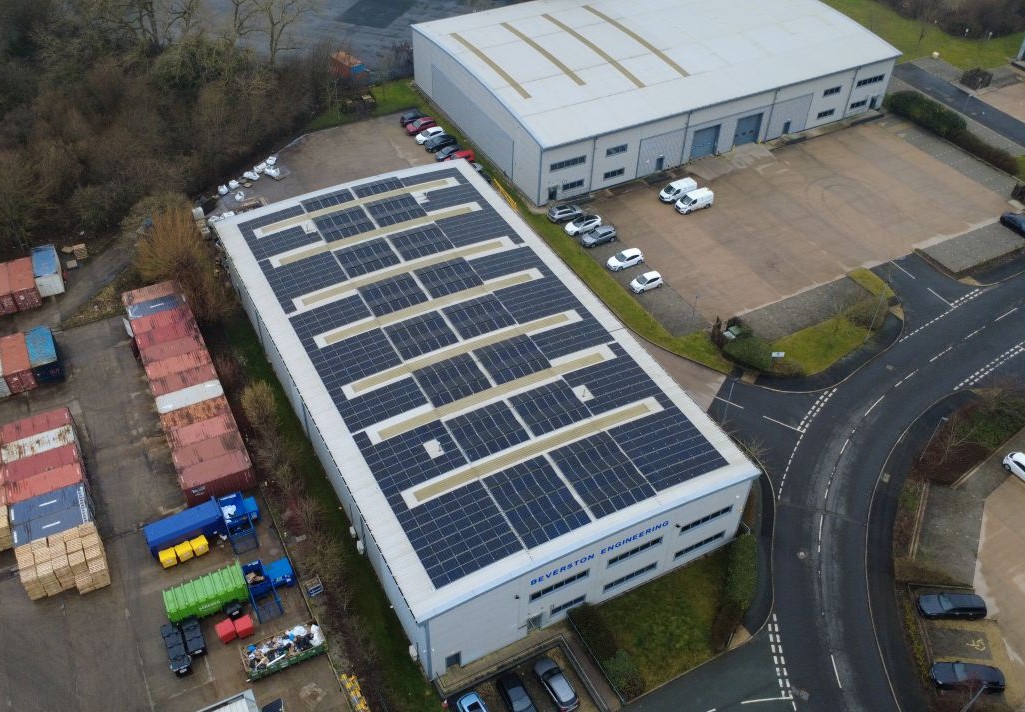
On-site commercial solar works differently. Instead of buying a better-priced unit of electricity, you generate some of your own, at a cost fixed when the system is installed. For every kilowatt hour that comes from your roof, the grid price stops mattering.
Solar is not a financial hedge. It does not offset price moves elsewhere in a portfolio; it removes your exposure on the units it generates. It covers daytime, behind-the-meter consumption, which for a multi-shift site may be around 25-30% of total demand.
Batteries can raise that share by moving day-time surplus into the early morning and evening, but they can add cost and complexity, so they should be modelled carefully to ensure their addition drives a ROI improvement, or additional benefits such as site resilience.
For energy-intensive heavy industry such as metals, castings and glass, rooftop capacity will touch only a small part of a very large load. There it complements process and procurement strategy rather than replacing either.
Manufacturers are not new to this. AMA Research estimates that factories account for 30-33% of UK non-domestic rooftop solar capacity, equivalent to roughly 1GWp across factory roofs.
The finance mechanics
How the asset is funded changes the risk it removes. AMA’s research indicates that on existing buildings, deployment has largely been through Power Purchase Agreements (PPAs), where the occupier buys the generated power from a developer-owned system, while owner-occupiers of new builds tend to own their arrays.
Ownership requires capital but captures the full benefit. A PPA needs none, but the detail matters. A fixed-rate PPA can give genuine cost certainty for a percentage of site demand, whereas a rate indexed to grid prices brings some of the volatility back. Finance directors should ask which they are being offered.
Payback is where the case stands or falls. Geo Green Power examined 12 installations at manufacturing sites they carried out between 2021 and 2025. The systems installed ranged between 62kWp up to 668kWp with full cost system payback periods ranging from 2.5 years to around 8 years.
| Ave. system size (kWp) | Ave. predicted payback period | Ave. £ saved after 30 years |
| 263 | 4.04 years | £1.81 million |
System payback and 30 year saving figures are based on a range of historical data and industry assumptions, which of course are difficult to model in such unprecedented times. Several of these sample installations were carried out during the energy crisis and start of the Ukraine war. This significantly increased cost savings and therefore reduced the predicted payback period.
It would be prudent to not rely on a single payback figure, test the investment across scenarios: prices flat, prices rising, prices falling. Ask how the case looks in the third. A project that only works if prices spike is a bet, not a source of certainty.
Four questions to take back to the business
- What is our forecast for our future energy onsite?
- How much of our demand falls in daylight hours, and how much of that could our roof serve?
- Would ownership or a PPA suit our balance sheet, and is any PPA rate fixed or indexed?
- Does the payback hold if prices stay flat or fall, not only if they rise?
Energy will stay volatile, and no single measure will remove that. But the question for finance directors is no longer only how to buy energy well. It is how much of the bill can become a number they can plan around, and at what cost. Answering that honestly is the start of a better energy strategy.
 Neil Beaumont is Business Development Director at Geo Green Power, with 26 years’ experience in energy and energy efficiency, including 15 specialising in solar PV.
For more articles like this, visit our Sustainability channel.