
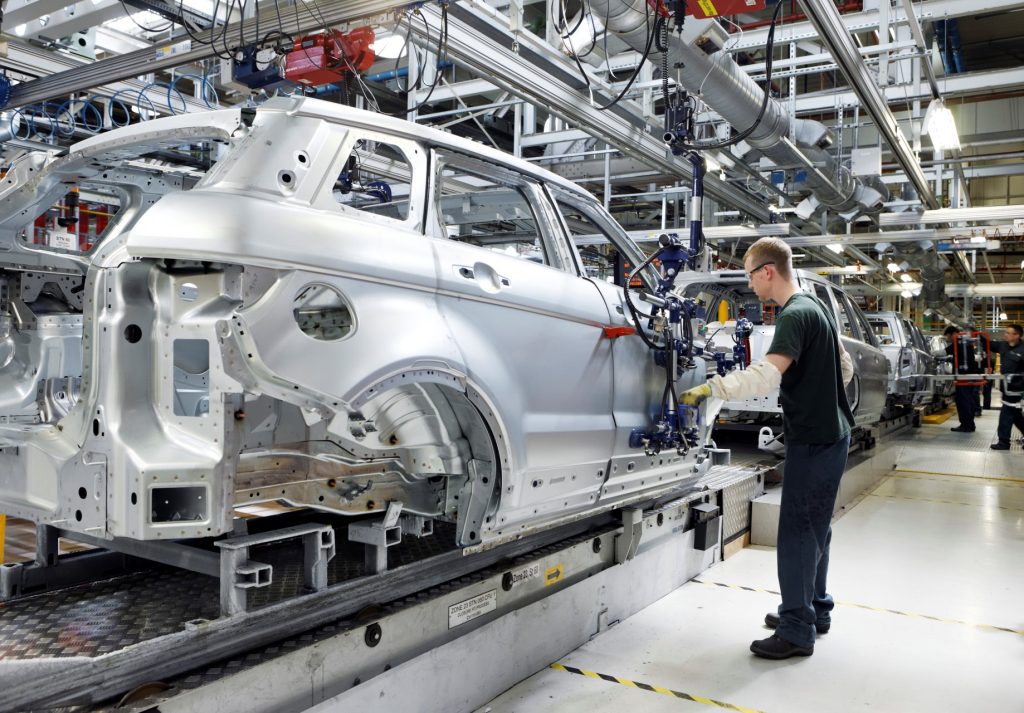
Yesterday, Jaguar Land Rover (JLR) announced it will cut around 4,000 jobs over the next two years, raising understandable concerns for company employees and those working across its wider supply chain.
The cuts, which are expected to come primarily from salaried and management roles, form part of a wider drive by the automotive giant to reduce costs and simplify its operations as it faces a challenging global market.
David Roberts, chairman of Evtec Group, said as many as 200,000 jobs could ultimately be tied to JLR, highlighting the significant economic footprint the company has across the UK automotive and manufacturing sector.
Evtec supplies components to JLR and David described the current situation as a “worrying time”.
Speaking to the BBC, he said: “A lot of the jobs here, if they go, they go, they leave the sector. And these are jobs with real skills that take years to build and it’s easier to lose them.”
Another JLR supplier, ZF Foxconn Chassis Modules (ZFFCN), described the news as a continuation of the pressure that is on automotive.
Adrian Chell, Plant Manager, told us: “We know that the JLR model line up in changing, and with that will come a reduction in production. With this, and off the back of the cyber-attack, I can only assume they feel the need to adjust their overhead structure.
“From our point of view, the models that we’re involved in, the Range Rover and Range Rover Sport, are still selling well. We don’t see the news as a worry for us directly at the moment. But clearly, the news is reflective of the continued pressure on the automotive sector.”
The cuts will take place over the next two years, with the majority expected to affect JLR’s UK operations and particularly its non-production workforce. The announcement comes at a difficult time for the business, which has been dealing with a combination of falling sales, US trade tariffs, intense competition from Chinese manufacturers, rising costs and the consequences of a devastating cyber-attack that halted production for several weeks last year.
The company is also navigating the considerable financial and technological challenge of transitioning its portfolio towards electrification.
JLR has committed billions of pounds to this transformation, with the company saying it will continue to invest £15-18bn over the next five years across electrification, digital technologies and advanced manufacturing.
Indeed, the announcement comes just days after JLR opened orders for its first fully electric Range Rover, while the company is also preparing to unveil a new electric Jaguar later this year.
David Roberts discusses how leaders can react to crisis at this year’s Smart Manufacturing Week
JLR has said the restructuring is designed to make the business more competitive, with the company targeting £1.7bn in savings over the next two years and aiming to lower its break-even point to around 300,000 vehicles annually.
However, concerns remain that reducing the number of highly skilled people within the business could have consequences beyond the immediate job losses.
For the West Midlands in particular, JLR represents a significant part of the region’s advanced manufacturing ecosystem. The company supports a large network of suppliers, engineering businesses and specialist manufacturers, while its workforce contains decades of accumulated automotive knowledge and technical expertise.
That has prompted a rapid response from the West Midlands Combined Authority, with Mayor Richard Parker announcing a £500,000 employment support package aimed at helping affected workers move into new roles.
The initiative is intended not only to help people facing redundancy find alternative employment, but also to ensure that the skills developed within JLR remain within the region’s manufacturing economy. The package could also be expanded through additional support from the Department for Work and Pensions.
Responding to the announcement, Mr Parker acknowledged the uncertainty facing JLR employees and their families, while stressing the importance of retaining the company’s highly skilled workforce within the region.
He said: “The news from JLR will be deeply worrying for thousands of workers and their families, many of them here in the West Midlands. My thoughts are with them first and foremost.
“JLR is hugely important to our region and employs some of the most skilled people in Britain. The company has faced an incredibly difficult period – from the cyber attack last year to the impact of the war in the Middle East and continuing instability around global tariffs and trade.”
Industry reacts
Stephen Morley, President of the Confederation of British Metalforming said: “News of 4000 redundancies by JLR brings into focus the immediate competitive crisis facing the UK automotive industry, a crisis that threatens jobs, investment and our domestic manufacturing capacity.
The announcement by the car giant was not unexpected but importantly has brought into focus the dangerous cocktail of extortionate energy prices, increased regulatory burden and the consequences derived from foreign vehicles being freely imported to the UK.
We welcome the support already announced by the West Midlands Combined Authority for workers facing the threat of redundancies – prompt action is always appreciated.
However, we also want to raise the potential impact this could have on the supply chain, many of whom are members of the Confederation of British Metalforming (CBM)
There are conversations taking place all the time with management teams about volumes not returning to the levels seen before the Cybersecurity attack and the growing uncertainty caused by a misjudged ZEV mandate, which requires vehicle manufacturers to sell an increasing annual percentage of fully electric cars and vans every year.
The CBM is today calling on equal support for the downstream supply chain to ringfence the skills and capability these companies bring to UK manufacturing and the ongoing push for greater sovereign capability.
We also want Andy Burnham and his ministers to urgently accelerate the ZEV mandate review, ensuring it does not become another exercise in delay.
Without urgent action on energy costs (the UK is 100% and 60% higher than the US and Germany respectively), business rates, labour costs, regulation and the treatment of imported electric vehicles, companies will have fewer incentives to invest in Britain and more reason to shift production and future investment overseas.
The government is therefore asking British manufacturers to invest in the transition to zero-emission vehicles while leaving them exposed to higher operating costs and increasingly intense competition from overseas producers.
Unless ministers act across the full range of pressures facing the sector, the consequences will be felt through reduced investment, lost manufacturing capacity, supply-chain closures and fewer skilled jobs across the UK.
Labour must now use the consultation to reform the ZEV Mandate and deliver a broader package of measures to restore the sector’s competitiveness.
It should also act on the urgent need for a joined-up industrial strategy that looks at energy, taxation, business rates, labour costs, regulation, trade policy, the ZEV Mandate and the competitive threat from state-supported overseas manufacturers as one connected issue.
The automotive sector needs government to be awake at the wheel, before more manufacturing capacity, investment and jobs leave the UK.”
For more articles like this, visit our Leadership channel.