While our focus is mainly UK, we never miss a chance to see how manufacturers in Europe are answering the biggest industrial challenges. In this case, it’s sustainability, at Fujifilm in The Netherlands.
The company’s Tilburg site is probably one of the most impressive manufacturing facilities I’ve ever visited.
The former photo film factory, first opened in 1988, has been gradually moulded into what it is today – a high-tech, sustainable production facility.
From the 1980s through to the 2000s, Fujfilm manufactured cameras and photographic paper. It still does today, better than ever in fact. Photographic colour paper, in particular, is produced with unerring refinement and quality at this site, and modern day innovation has enabled incredible breakthroughs. Fujifilm is able to make photo paper that mimics the appearance of canvas or velvet.
But with the volume of photographic paper decreasing more recently in Tilburg, pockets of the site have starting venturing into new endeavors.
A new life science factory, for example, where cell culture media are produced. Cell culture media are used in the biopharmaceutical industry and serve as nutrients for cells when making drugs, like the COVID vaccine, for example.
An odd choice of market to diversify into perhaps? Well, preventative healthcare and treatment are exciting fields, full of modern innovation, and they’re growing rapidly.
Tilburg was specifically chosen as the first location for Fujifilm in Europe to set up a life sciences centre because of the expertise that existed at the site. Knowledge of complex technological processes in film and photo paper production were transferable, remarkably.
The facility itself is also well geared to meet the energy intensive production demands, with a capacity of 320,000kg per year of powder and 470,000 litres per year of liquids in the first phase.
The circular manufacturing centre at Tilburg is another little factory within a factory. Since last year, the company has been collecting used toner cartridges from printers sold throughout Europe.
The used printer cartridges are sent to Tilburg and undergo a thorough process of disassembly, cleaning, inspection and refurbishment in order that they meet the requisite quality standards.
Again, Fujifilm chose the Tilburg site for this because of its ecosystem. And probably because, as mentioned, it’s just a very impressive place.
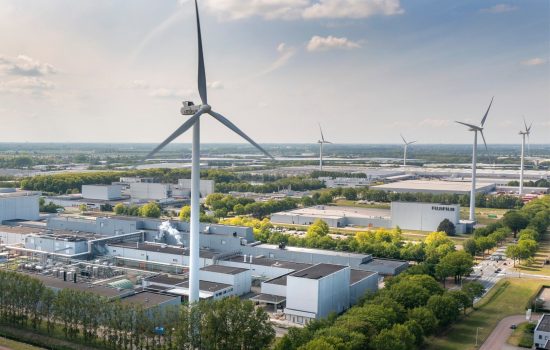
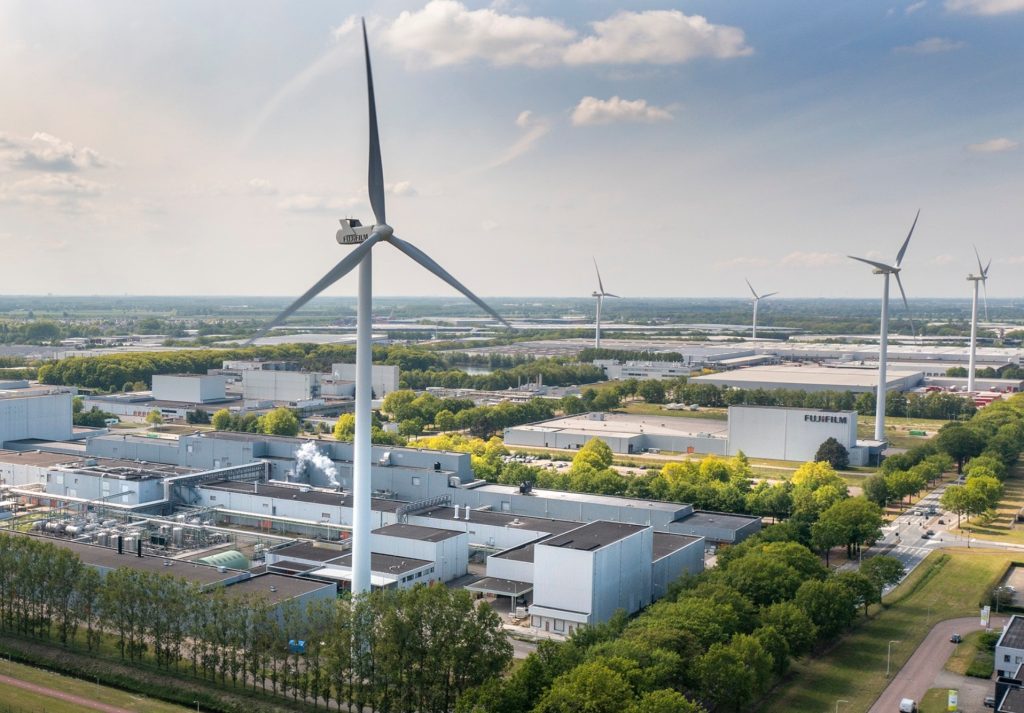
Five wind turbines loom over the vast facility, and contribute to providing Fujifilm in Tilburg with 100% of its electricity from renewable sources. There is also an on-site water purification plant, where the combined wastewater flows of Fujifilm and three neighbouring companies are cleaned.
And, the reason for my trip, at an inaugural grand opening we were shown a new 7MW E-boiler which is used to produce heat and steam, and will replace 50% of natural gas usage, making Tilburg one of the most energy efficient and sustainable plants in Europe for Fujifilm.
Some truly amazing initiatives to support the hive of activity in Tilburg. But grand plans are needed to meet grand ambitions, and CO2 neutrality by 2030 for Scope 1 and 2 is the goal.
Can the company pull it off? Read the full article here and judge for yourself.