
The Manufacturer took another European trip earlier in the year, visiting Fujifilm’s Tilburg site in the Netherlands. You’ll probably know Fujifilm from its photographic film products, but in Tilburg, there’s so much more. I flew out to see the unveiling of a new electro-boiler which, along with five previously installed wind turbines, is helping the site’s ambitious goal to become carbon neutral by 2030.
Key takeaways
- Despite all the initiatives at this plant, two more “significant projects” need to take place to reach the CO2 neutral 2030 target
- The diversification from photographic film into biopharmaceutical was a natural one for Fujifilm, given the expertise in quality and accuracy
- Everything is connected at this site, and every new project is geared towards sustainability
- Sustainability may require up front cost, but the long-term benefits need to be explained to investors and stakeholders
FAQs
- What are cell culture media?
- What is the Tilburg site’s 2030 target?
- How big is the Tilburg site?
- How much electricity is produced by each of Fujifilm’s wind turbines?
The former photo film factory, first opened in 1988, has been gradually moulded into a high-tech, sustainable production facility. Back in the 1980s, 1990s and 2000s, Fujfilm manufactured cameras and photographic paper. It still does today, and in Tilburg, photographic colour paper is produced with unerring refinement and quality.
It’s used in prints, posters, calendars and photo albums. Larger format rolls of paper are also produced, and often used for the professional exhibition market. Innovations, bore out of years of knowledge and experience in new product developments, has enabled breakthroughs such as photo paper that mimics the appearance of canvas or velvet.
But the volume of photographic paper produced here has decreased in more recent years. At the end of 2021, Fujifilm opened a new life science factory in Tilburg, where cell culture media are produced. Cell culture media are used in the biopharmaceutical industry and serve as nutrients for cells when making drugs, like the COVID vaccine, for example.
On the face of it, the biopharmaceutical market struck me as an odd diversification market for a photographic film company. It will later become clear how this came about. It’s a market growing at speed, which means Fujifilm is continuously expanding its activities in the field of preventive healthcare and treatment.
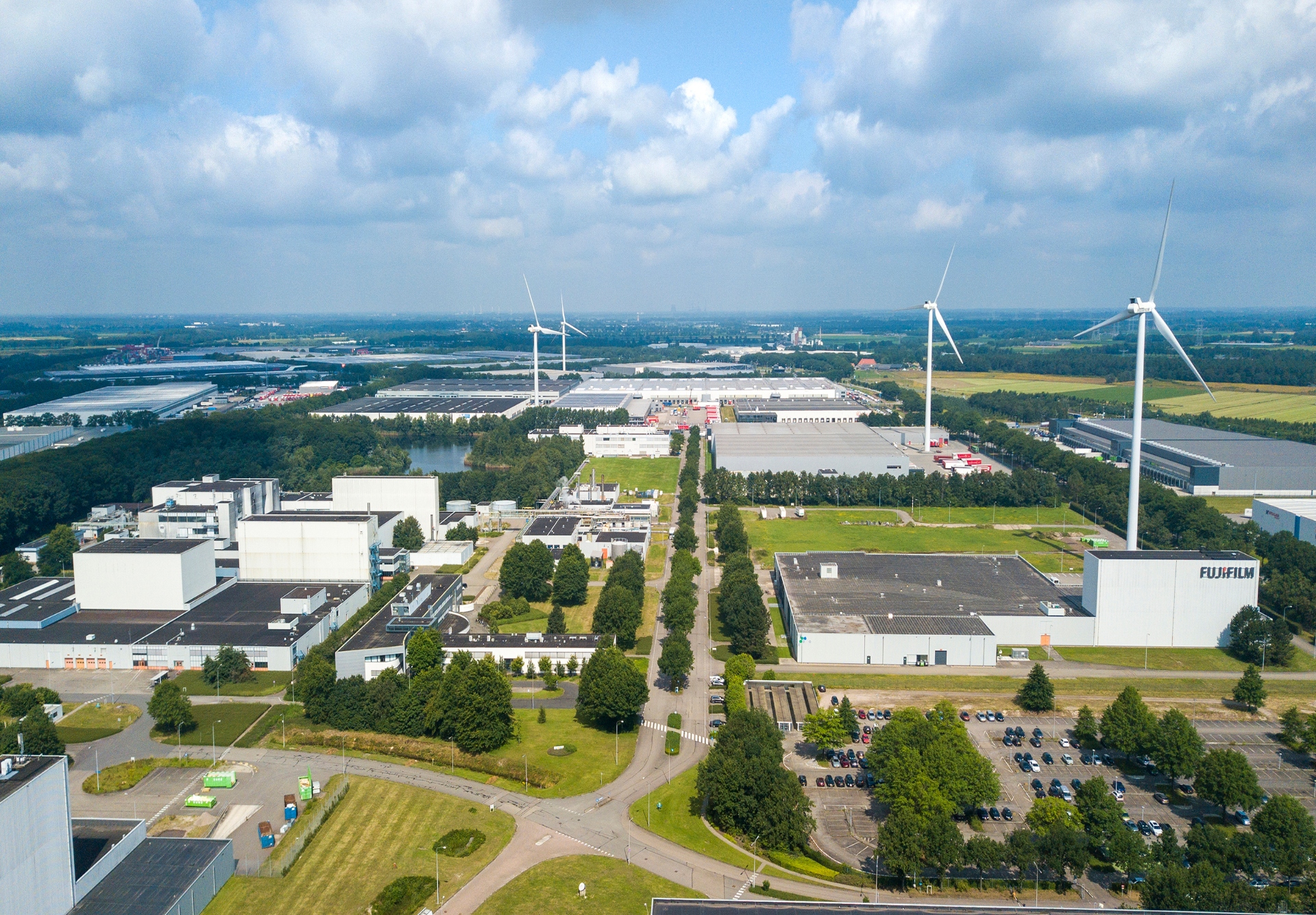
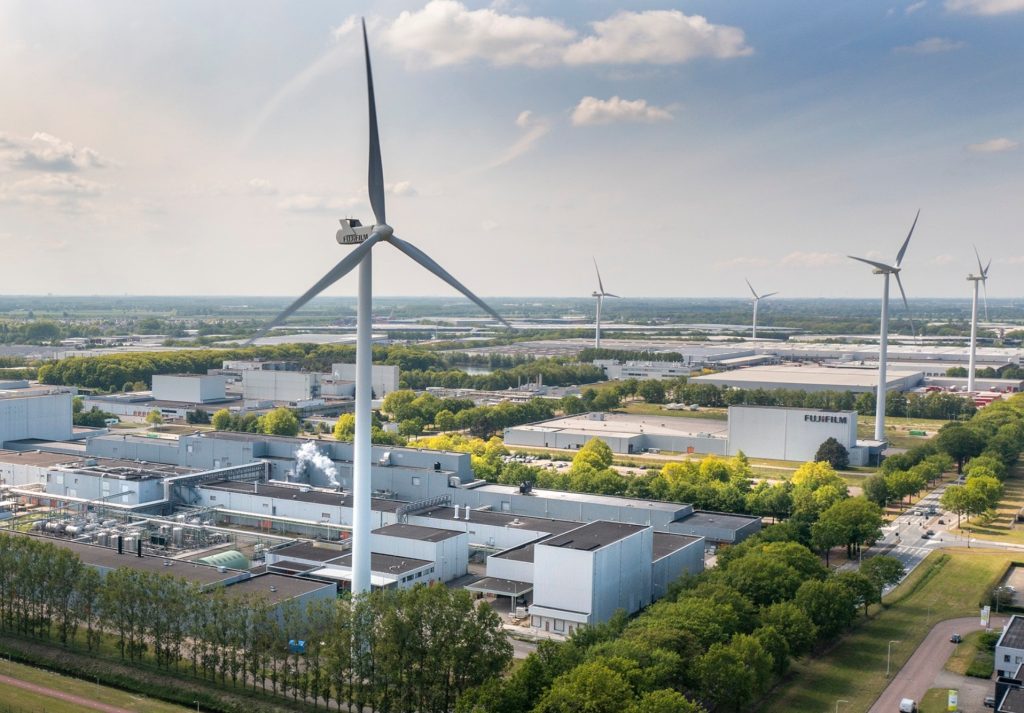
In addition to biopharmaceutical production, the Tilburg site is also home to a circular remanufacturing centre – for the remanufacturing of printer cartridges – an operation that was started last year. It has an on-site water purification plant, where the combined wastewater flows of Fujifilm and three neighbouring companies are cleaned. The company also uses 100% of its electricity from renewable sources, partly generated by five on-site wind turbines. And still, this isn’t enough.
At an inaugural grand opening, we were shown a new 7MW E-boiler which is used to produce heat and steam, and will replace 50% of natural gas usage, making Tilburg one of the most energy efficient and sustainable plants in Europe for Fujifilm. A truly amazing site, but it needs to be if the company is to achieve its goals – to be CO2 neutral by 2030 for Scope 1 and 2.
Fujifilm Holding also has the ambition to achieve a 50% CO2 reduction across the complete product lifecycle in the same time-frame, which also accounts for Scope 3 emissions.
How it started
As we sat down in the boardroom at the Tilburg site, the question was asked by Albert van Maren, President and Managing Director of Fujifilm Manufacturing Europe, “What would you like to know?” It was a tough question, because where do you begin? The Tilburg site is 50 hectares, one of the largest in Europe. And as you’ve just read, there is so much going on; from remanufacturing to life science innovations, it is a hive of intriguing activity.
Launa Porfido, Head of Corporate Communication and ESG Management for Fujifilm Europe, thankfully stepped in, as me and a room full of international journalists scratched our heads for an opening question. “I think it would be good if we give an overview of the transformation of the site, with the focus on sustainability,” she said.
“This site is the great example of the Fujifilm world, and today we celebrate another step in that journey, (with the unveiling of the E-boiler) but I think it’s important to state that Tilburg started this commitment to sustainability many years ago.”
Almost 20 years ago, to be precise. Albert continued: “We care about the environment and in 2006 we were aware that if we want to sustain our position as an industrial manufacturer in Europe, sustainability should be a key focus area.” Firstly, the company explored the opportunities around green electricity. From there, the investigation began into how plausible it would be to install wind turbines on land.
Wind turbines are common across Europe, but putting five up in an industrial area close to a city required some negotiation with the government in the Netherlands. The cost was also prohibitive – it would take an investment that totalled €50m, which at the time proved difficult.
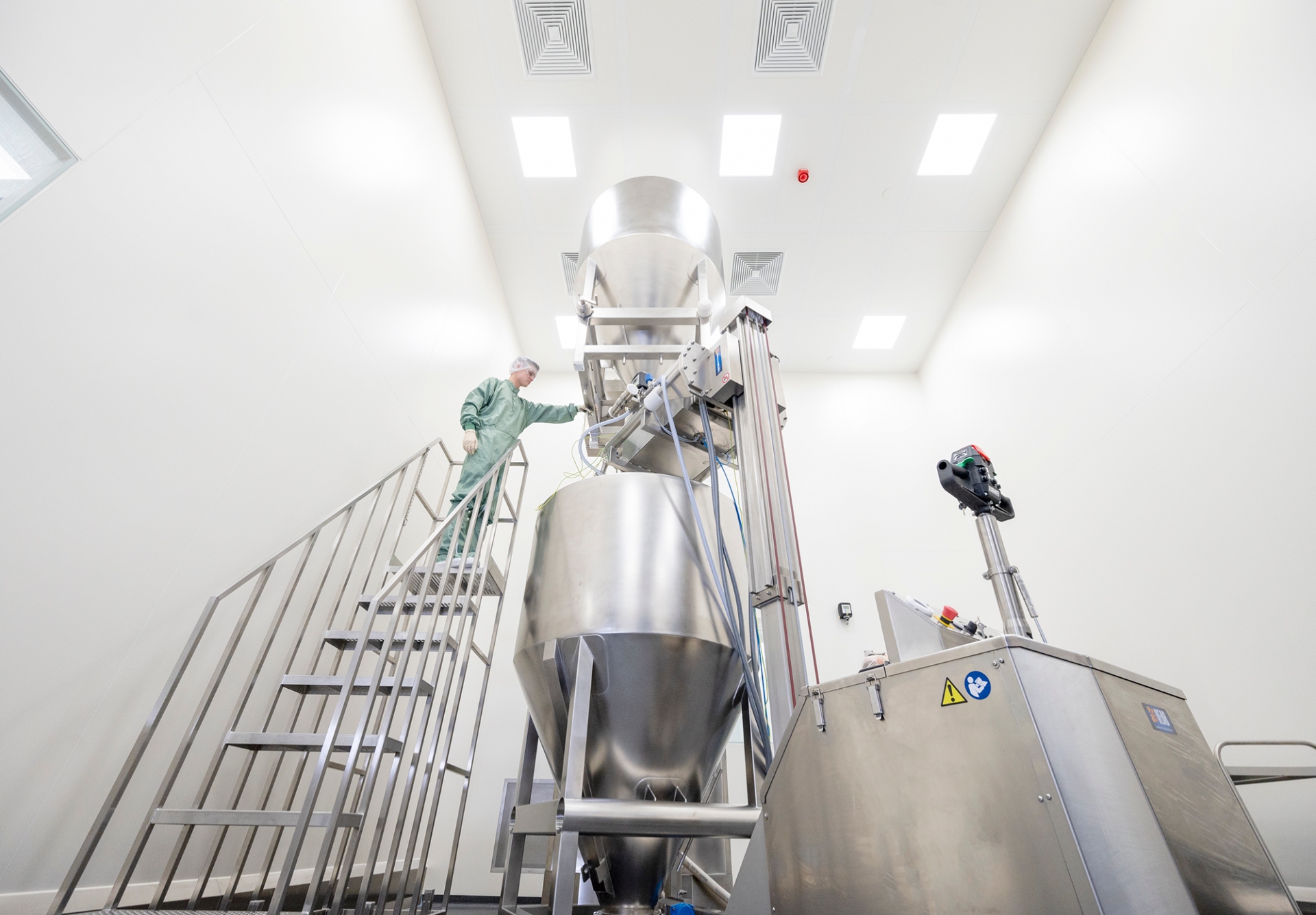
The life sciences manufacturing centre is now a fully carbon neutral operation
It took around five years for the company to get permits and find investment, which came from the electricity company that Fujifilm partnered with. “We invested in the land, and the preparation that was needed,” said Albert. “We negotiated for the price of the electricity, which is connected directly to our grid, through a closed distribution network.”
The five wind turbines that loom over the Tilburg site generate around 2MW each. “Because of our processes here, we need energy – in life sciences, and to dry colour paper after coating, for example,” said Albert.
“The wind turbines went up in 2011, and at the time, this was providing us with 20% of our electricity need, because we had a large factory running. In 2016 this was complemented with electricity from the public grid, and obtaining European certificates of origin for wind meant we were able to get 100% of our electricity from renewable sources. This has been the case ever since.”
In the meantime, the company took steps to optimise and redesign its processes to fit the modern investments it was making. The production processes used in the life sciences manufacturing facility for example, were consciously designed to run off electricity. The installation of heat pumps made this possible.
However, the challenge was that the building, like most across the site, was built 30 to 40 years ago, and at that time produced colour negative film for photography. This part of the site has office areas which are connected to the site’s utility centre, and used gas generated steam for heating
Boling point
This is where the E-boiler comes in. Sander Vermeulen, Chief Operating Officer at Fujifilm Manufacturing Europe said: “To change the systems to a different kind of heating in that area was too expensive. Now, with the introduction of the E-boiler, we can run our office heating on green steam.”
The steam from this site originally came from two natural gas boilers. The new E-boiler, producing 7MW of electricity, will reduce natural gas used across the site by 50%. The site now has three boilers – two gas and one electric. The E-boiler needs to run alongside one of the natural gas boilers to reach the total energy capacity across the whole site – a ‘hybrid’ system, essentially.
The second, obsolete natural gas boiler will be switched off, but kept in reserve to backup any potential breakdown to the gas boiler or, in the unfortunate event, the E-boiler. After all, the site needs to have some form of power source in the event of an emergency.
Green steam is generated for heating and humidity control in factories and offices across the site. This runs to the former offset plate manufacturing site and the main office, as well as the former research lab. Steam, as mentioned, also runs to the photographic paper manufacturing site, and is used to dry colour paper after it’s been coated.
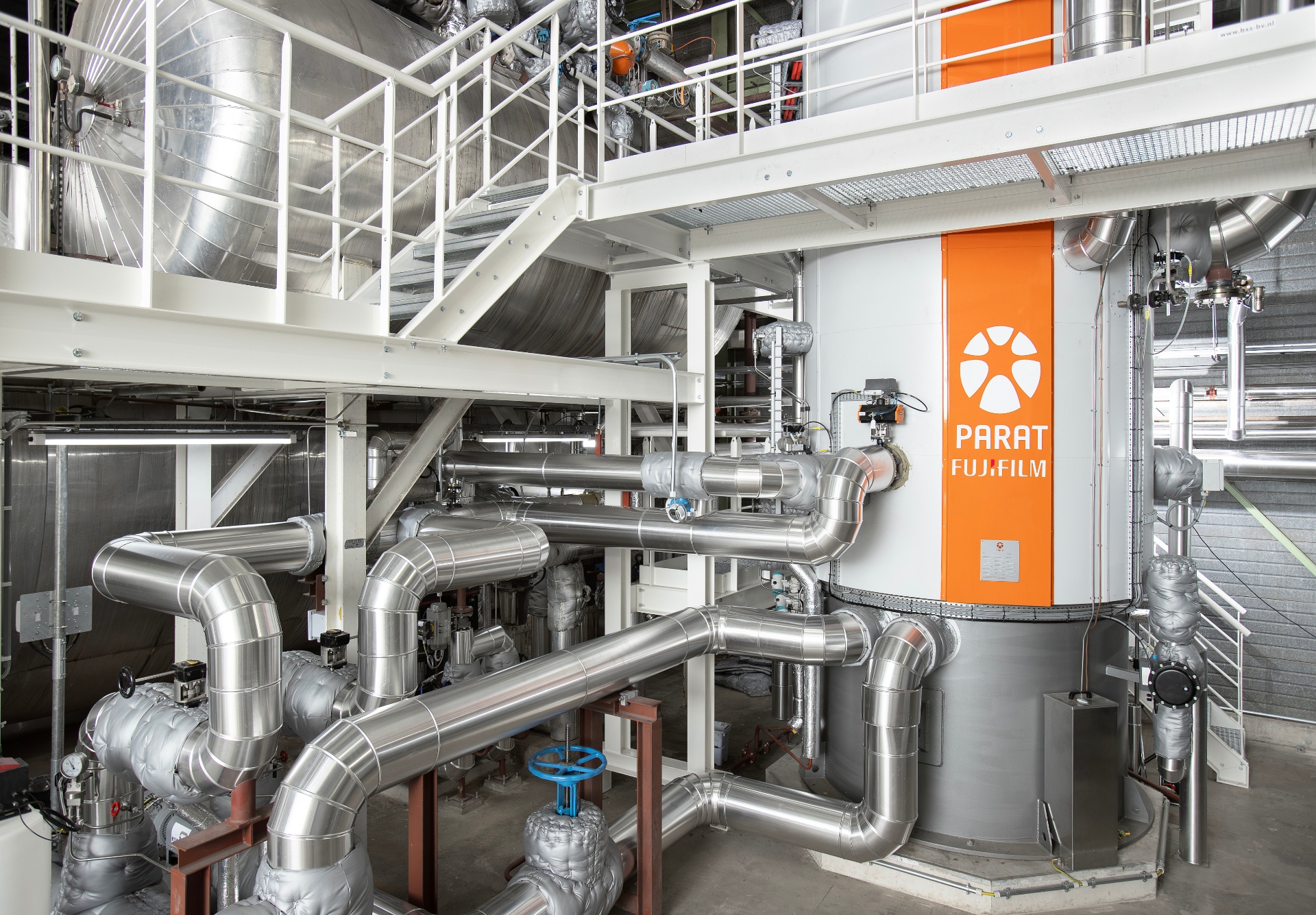
Used to produce heat and steam, the E-bolier will replace 50% of natural gas usage at the site
“Twenty per cent of the green steam produced is reserved for the Life Science Manufacturing plant, ensuring that production here is always CO2 neutral.” said Sander. As mentioned, the production process to produce cell culture media is fully electrified, and now so is all the steam to heat the facility and offices and environmental stability to mimic physiological conditions, allowing cells to thrive outside their natural habitat.
In 2020, Tilburg was chosen as the first location for Fujifilm in Europe to set up a life sciences centre because of the expertise that existed at the site in the complex technological process. The facilities are well geared to meet the production demands, with a capacity of 320,000kg per year of powder and 470,000 litres per year of liquids in the first phase.
The on-site water purification plant allows a flow of water for injection (WFI) quality water and a water source for the security of supply. The site is also well-positioned for growing market demand, with room for future expansion in the life science manufacturing environment. Not least due to the 22,800 square meters of space, with the option to expand and double the capacity.
Re-cartridgeing
The circular manufacturing centre at Tilburg also deserves a momentary spotlight. Since last year, the company has been collecting used toner cartridges from printers sold throughout Europe.
Fujifilm Business Innovation produces office printers, as well as solutions in graphic communications, both in-plant and production print environments with high-volume printing requirements. The used printer cartridges are sent to Tilburg and undergo a thorough process of disassembly, cleaning, inspection and refurbishment in order that they meet the requisite quality standards.
Again, Fujifilm chose the Tilburg site because of its ecosystem, the size of the site and its central location in Europe. The company has expressed its intention to extend these remanufacturing processes in the future to other products, such as multifunction printers and production printer spare parts.
Thanks to the 10MW of wind energy being produced by the site’s turbines, the circular manufacturing centre, like the life sciences centre, is achieving virtually zero carbon emissions from the electricity it uses.
An ambitious target
The Tilburg site aims to be carbon neutral by 2030. And the Fujifilm group as a whole wants to achieve the same milestone ten years later. There’s no question, the site is impressive by any of the high standards that we’ve reported on at The Manufacturer.
And Tilburg is a shining example in the Fujifilm business, not just across Europe, but even when compared to the company’s Japanese sites. “I would point out that regulation is different in other countries,” said Sander, “Subsidies aren’t as easy to come by in somewhere like Belgium, for instance.
“The investment in our E-boiler was €2m, but this wasn’t a CAPEX investment. By using electricity instead of gas we are compensated if we make a loss – not 100%, so there is still some risk to these projects, but it is managed. Different countries and sites have their own unique challenges when it comes to this.”
An impressive site, yes, but has it over-reached with its 2030 target? It’s incredibly ambitious, and to achieve it, the site will have to innovate and invest further. “Are you optimistic about reaching your sustainability goals, or are you feeling hurried?” Asked one of the journalists around the boardroom table.
Albert puffed out his cheeks, “I feel determined,” he responded. “Optimistic is maybe a big word. And yes, I think we do feel a little hurried to decide on the next step, because 2030 is soon, and time flies when you’re having fun.
“If we want to be CO2 neutral by then, I think we need two more significant projects. So, that needs to be decided, approved and invested in. And if the Fujifilm group wants to reach its 2040 target, then it is clear, we need to invest. This will probably cause some increase in cost to our customers, but from what we are seeing, especially in the biopharmaceutical area, they want this.”
Read similar articles in our Sustainability section