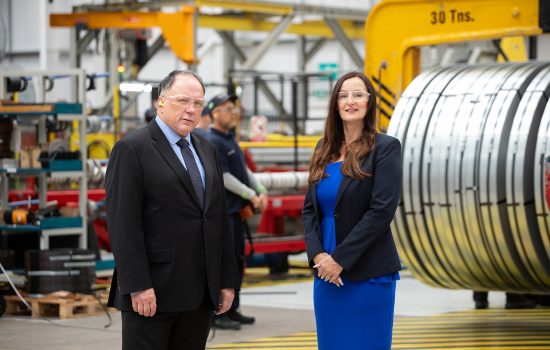


Stephen Morley, President of the Confederation of British Metalforming, addresses the white elephant in the ‘electrification’ room and explains why changing the direction of transition is imperative for protecting the UK’s automotive industry.
“To be, or not to be, that is the question”. In Shakespeare’s classic, Hamlet contemplates existence, suffering and consequence.
Today’s global automotive industry finds itself in a similar existential moment, not questioning whether electric vehicles will define the future, but increasingly feeling hamstrung by government policies whilst trying to navigate one of the most significant industrial transformations in its history.
The move to EVs is not up for debate. It is underway, irreversible and technologically inevitable. The bigger question is whether the regulatory architecture guiding the transition, particularly in the UK, is calibrated to reality.
The UK ZEV mandate: Catalyst or constraint?
The UK Zero Emission Vehicle Mandate requires manufacturers to meet escalating EV sales targets or face fines of £12,000 per non-compliant cars. By 2035, all new car sales must be zero emission.
In principle, the mandate provides clarity and long-term direction. In practice, it is creating acute short-term strain, especially with the economic landscape severely altered by global events and contributing to a largely unachievable target. Whilst no one is detracting from the end goal, the journey to get there needs urgent revision.
Industry estimates suggest potential exposure to billions in penalties if targets are missed, figures frequently cited at up to £4 billion over the compliance period. While fines flow to the Treasury rather than directly funding consumer incentives, the optics remain politically charged. Are manufacturers being penalised for demand that has not yet fully materialised? The UK market risks becoming compliance driven rather than consumer led.
Managing the mix: A quiet volume correction
Misguided policy that is ‘incentivising’ OEMs to meet ZEV targets and avoid fines is also having a negative impact on reducing internal combustion engine supply, with car makers prioritising higher margin derivatives and curtailing overall production volumes.
The result is not simply a shift in powertrain mix, it represents a potential contraction of the total market. For example, lower volumes increase unit costs and higher prices dampen demand. Weaker demand then forces further volume management. This is not theoretical and is increasingly visible across European markets – the reality is this is not sustainable for an already under pressure car sector.
A continental headwind
The pressure is not unique to Britain. In Germany, the abrupt withdrawal of EV subsidies sent shockwaves through demand. Even industrial heavyweight Volkswagen has announced unprecedented restructuring measures, including potential factory closures. This represents a historic moment for a company that has long symbolised German ‘industrial resilience’.
Across the EU, manufacturers are grappling with slower than anticipated private EV uptake, elevated interest rates and intensifying competition from Chinese OEMs. That’s before you throw in uneven charging infrastructure rollout and fragile consumer confidence.
This is a structural transformation colliding with economic fragility. The EU has reacted by relaxing their EV targets, giving some flexibility on targets and sanctions on EU imports. Our government now needs to respond in kind.

The risk to UK manufacturing
The deeper question extends beyond compliance targets. Can the UK remain competitive as an automotive manufacturing base during this transition?
High energy costs, battery supply chain dependency, trade friction with the EU and regulatory rigidity create cumulative pressure. If volumes decline materially over the next five years, the impact will not be confined to just OEM balance sheet, it will reverberate across the entire component supply chain, retail networks and logistics providers.
A structural reduction in UK volumes would be far harder to reverse than a temporary dip.
The case for calibration, not capitulation
None of this argues for abandoning the 2035 objective. The direction of travel must remain clear, as investment decisions depend on it.
There is a growing case for pragmatic adjustment and greater flexibility mechanisms within the ZEV framework. Relatively easy decision could be made to introduce targeted consumer demand stimulation with accelerated infrastructure deployment, whilst policy stability will encourage capital investment going forward.
The difference between a disorderly and managed transition could well define the next decade of British automotive history.
An idealistic policy with consequence
The industry is not debating whether to electrify, that question has already been settled.
It is grappling with how to deliver transformation at scale whilst feeling constrained by the very policies designed to accelerate it. This has now come to ahead and was laid bare at SMMT Electrified 2026, with Mike Hawes stating that ‘decarbonisation could mean deindustrialisation’. He also told hundreds of delegates in London that the ‘EU Industrial Accelerator Act discriminates against UK are car manufacturers and its supply chain’.
Martin Sander, Board Member for Sales, Marketing and After Sales at Volkswagen Passenger Cars, pointed out that the automotive business has a huge responsibility. “It needs to be nimble, reactive and quick to adapt new processes and change so that we can take all the advantages that come with new technology , huge responsibility for the business but also huge responsibility for policymakers (sic government) to put the right policies in place to support businesses on this tremendous transition and also support consumers, our customers.”
The UK government now faces a pivotal choice. Maintain strategic clarity while giving industry breathing space, or risk overseeing a contraction that weakens the industrial base it seeks to modernise.
An early review of the ZEV mandate is welcome, but industry cannot afford for it to be a drawn-out affair, it needs to be decisive and pragmatic.
Starmer and Co must learn from the failures of the recently released Steel Strategy, where only the voice of the steelmakers was listened to. It is important that they make the conversation inclusive to all parties, including ministers, OEMs and the supply chain. Only then will it arrive at the right framework for future success.
The transformation to EV is here to stay. The question is whether we allow it to strengthen the industry or strain it beyond resilience. We must avoid our ‘Hamlet’ moment at all costs.
For more articles like this, visit our Leadership channel.