
Manufacturers have always learned more by making more. Industrial AI is narrowing that advantage. It now favours those that learn the most from every run and act on it before the next. Sebastian Pattinson, Associate Professor from the Institute for Manufacturing at the University of Cambridge and Co-founder of the industrial AI spinout Matta, explains why the best measure of a factory’s competitiveness may be how quickly a lesson can be learned in one place and improve what happens in another.
A fault appears on a production line. An experienced engineer finds the cause, adjusts the process and clears it. A month later, the same fault appears at a sister plant 200 miles away. A different team starts from nothing.
Manufacturers solve problems like this every day, yet critical expertise remains trapped within an ageing workforce, isolated with one person, machine or site, forcing organisations to solve the same problem repeatedly.
Q&As
- How is AI changing manufacturing competitiveness?
A: Competitiveness is shifting from simply producing more to learning more from every production run and acting on that learning faster. AI can help factories turn production data, video and human expertise into actionable improvements. - Why do manufacturers often solve the same problem repeatedly?
A: Critical expertise is often trapped with individual engineers, machines or sites. Different plants may also use different terminology for the same fault, making it difficult to recognise and transfer solutions across the organisation. - What can newer AI systems do that traditional analytics cannot?
A: Traditional analytics are effective with structured numerical data, but newer AI can analyse production video, identify unfamiliar faults, connect observations with engineering knowledge and suggest causes and responses. - Why isn’t collecting more data enough?
A: Data only becomes valuable when it connects to human judgement and action. Much manufacturing expertise exists in people’s heads and is developed through real-world decisions. AI should capture that expertise, explain reasoning and help transfer knowledge rather than simply automate tasks. - What could become the key measure of manufacturing performance?
A: The article argues that manufacturers should measure how quickly they turn a problem into a validated improvement, how far that improvement spreads, and how often the same problem is solved twice. The strongest manufacturers will create a cycle where faster action generates more learning, which leads to even faster improvement.
Volume used to be the only way to learn
Scale used to set the pace of learning. A manufacturer that made more, met more problems. And every problem it solved made the next unit cheaper. In 1936, Theodore Wright quantified this, showing that each time cumulative output doubled, the cost to build one aircraft fell by a consistent percentage.
Across the 20th century, developments such as statistical process control, continuous improvement and automated control made it easier to detect variation, test improvements and stabilise production. Each raised how much a factory could learn from every unit it made but did far less to ensure that a lesson learned by one team became usable knowledge for another.
Now data and learning may matter more than volume The dependency of learning on volume is what is now changing. A factory still has to run to learn anything. But how much it takes from each run is no longer limited to what someone thought to measure, or knew how to write down. The question is therefore no longer only how much a factory produces. It is how much it learns from what it produces, and how fast that knowledge reaches the people who can act on it.
Many manufacturers already read structured signals well. Analytics and conventional machine learning have handled sensor readings and quality data for years. Where a problem reduces to a well-defined numerical relationship, those methods often remain the right tool.
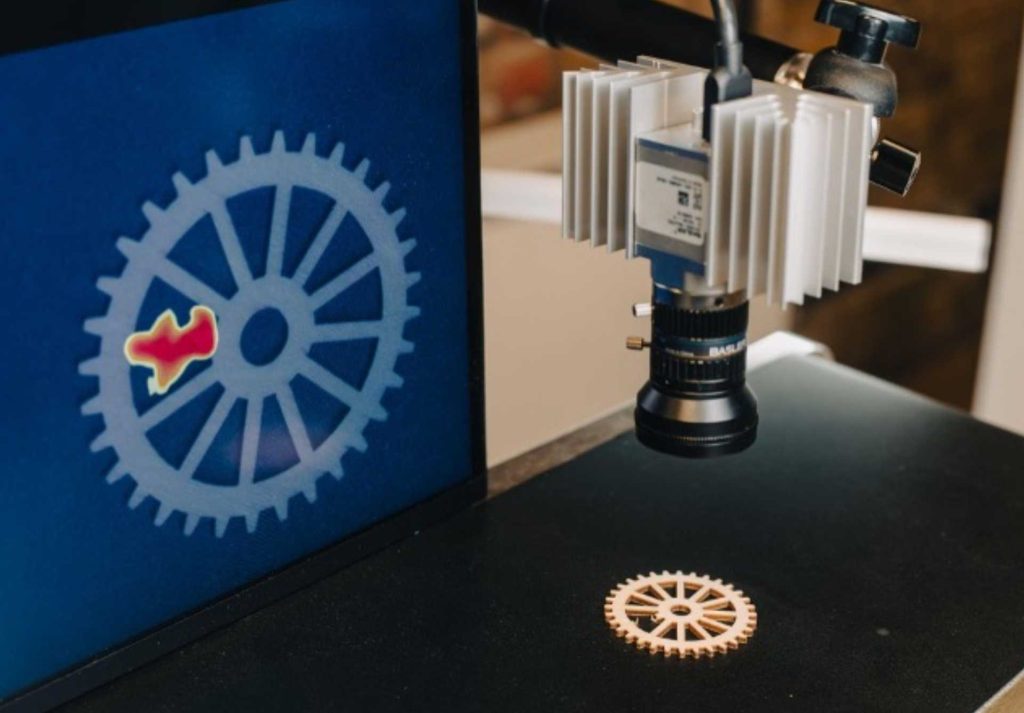
What has changed is the range of evidence a factory can act on. Newer AI methods can now extract knowledge from sources that were impractical at scale, such as production video. They can also recognise faults they have never seen before, so a factory no longer needs a perfectly labelled example of every failure. Reasoning systems can then go further. They can bring general engineering knowledge to what they observe, then propose a likely cause and a response.
In recent research published by the Institute for Manufacturing at the University of Cambridge, it was demonstrated how such a system could perform manufacturing tasks, explain its decisions and respond to unfamiliar problems. Over time, these systems could help manufacturers solve problems faster, increase output, accelerate innovation and make scarce expertise available across the organisation.
Speaking the same language
Direct observation also solves a problem that volume never could. One plant calls it surface contamination. The second calls it poor finish. The third just logs it as ‘part wrong’. Manufacturers run on a patchwork of systems and local vocabularies that record the same fault in incompatible ways. A fix found in one place is rarely recognised as relevant in another.
A system that watches production directly does not depend on how each site chose to label things. It can establish that two differently described problems are in fact the same, enabling the solution to be transferred between them. This layer need not replace MES, SCADA or ERP but sits across them and gives separate plants one shared account of what is happening on the shop floor.
The question is no longer only how much a factory produces. It is how much it learns from what it produces, and how fast that knowledge reaches the people who can act on it. AI can capture more of what happens in production. But data often becomes most valuable when it connects to human judgement, and much of that judgement stays in people’s heads.
Sebastian Pattinson, Associate Professor, Institute for Manufacturing, University of Cambridge
 The question is no longer only how much a factory produces. It is how much it learns from what it produces, and how fast that knowledge reaches the people who can act on it. AI can capture more of what happens in production. But data often becomes most valuable when it connects to human judgement, and much of that judgement stays in people’s heads.
Large manufacturers keep real advantages. Higher volumes create more chances to see faults, test changes and refine production. But Wright’s law contains its own limit. The thousandth identical unit teaches far less than the tenth. High-mix, low-volume production is information rich by comparison, because every changeover is an experiment. What those manufacturers have lacked is a means of interpreting and keeping the information from these lessons. This is what industrial AI now addresses.
AI is not yet widely adopted in manufacturing
A McKinsey survey of manufacturing COOs found only two per cent said AI was fully embedded across operations, while two-thirds remained at the exploration or limited deployment stage. Additionally, almost 60% had no targets for measuring value from AI implementations.
UK Office for National Statistics data suggests that just over a fifth of British manufacturers use at least one AI application, significantly below several other sectors. A Make UK survey similarly found just two per cent have AI widely embedded across operations. Where AI is used, 83% apply it to business support functions such as HR, finance and administration, against 11% in production and six per cent in quality control. AI has mainly reached the accounts department, not the shop floor.
Data is not the same as knowledge
AI can capture more of what happens in production. But data often becomes most valuable when it connects to human judgement, and much of that judgement stays in people’s heads.
An experienced welder hears a weld going wrong. A moulding technician adjusts a parameter because the process feels as though it is drifting. Interviews and written procedures do not capture this well. The expertise appears during production, when someone notices a change, weighs the causes, chooses a response and watches the result. To keep it, a system must record decisions in context and learn from what happened next.
Those decisions are also how expertise is made. Routine faults have always been the training ground for practical judgement, so automating them can raise short-term productivity while closing the path that produces the next generation of experts. The opportunity is to use AI both to retain that expertise and to explain its reasoning, shortening the apprenticeship rather than removing it.
How quickly can factories turn learning into action?
Capturing knowledge is not enough. Advantage depends on how quickly a manufacturer can apply it. Short feedback loops need clear ownership and teams with the authority to act without escalating. AI will usually start as an adviser, which is how operators build trust in it. It should not stay on permanent probation. Manufacturers need a deliberate path from observation to advice, to approval, and where warranted, to autonomous action, with each step earned by the evidence of the last.
The most revealing measure may be the interval between detecting a problem and validating a change that stops it recurring. Two other questions are how far a fix travels, and how often the same problem is solved twice. As material, labour and energy costs rise, a recurring fault is more than wasted production. It is a loop that failed to close. The best manufacturers will be those that act the fastest on what they learn, and in doing so learn faster still.
A compounding advantage for the UK
This shift matters for the UK in particular. The British manufacturing base runs from aerospace, and automotive to pharmaceuticals, food, drink and chemicals. These sectors operate at very different scales. Many face similar pressures: variable inputs, scarce expertise, rising costs, thin margins and expensive disruption.
When production moved overseas, some of the practical knowledge created by making things moved with it. Engineers and operators solved problems where the work happened. That experience was collected in the companies and countries that held the volume.
The value differs by sector. In aerospace and high-mix work, AI makes each run more informative and cuts the need to relearn. In food, drink and other high-throughput plants, it helps teams react faster to variation, protect quality and raise output.
So the opportunity is larger than automating single tasks. Better observation produces better decisions. Effective action creates more knowledge. Each improvement strengthens the next. For an economy that will typically not compete on volume alone, the ability to learn and act faster may become the defining industrial advantage.
For more articles like this, visit our Data & AI channel