

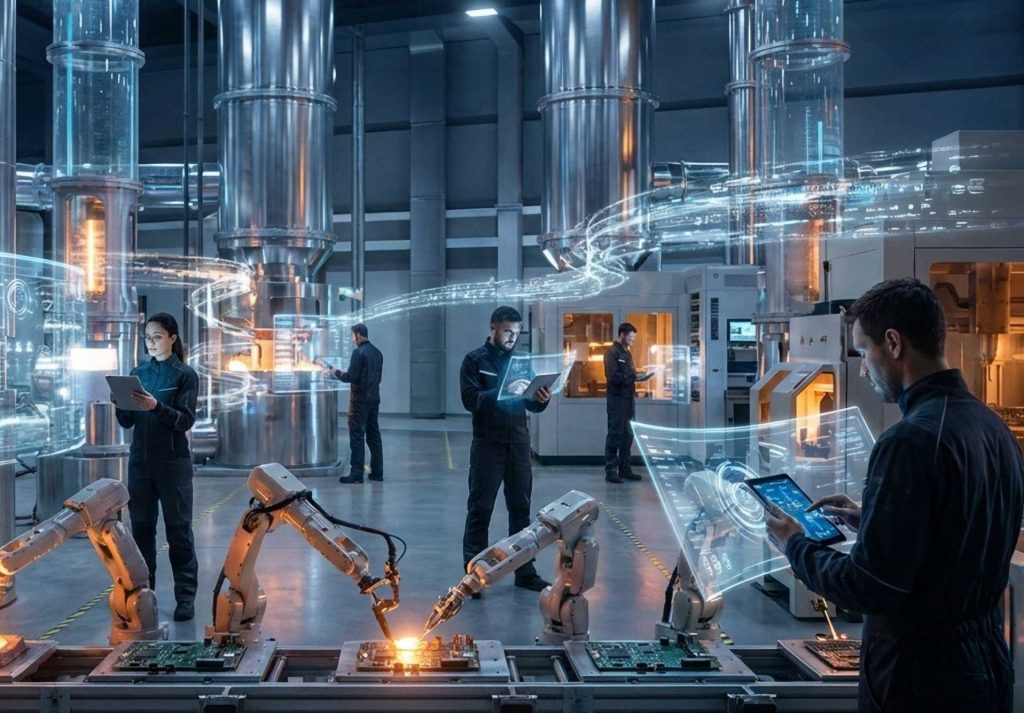
As manufacturers seek to move from AI towards real-world deployment, collaboration between technology providers and industrial specialists is becoming critical. Matta, an industrial AI spin-out from the Institute for Manufacturing (IfM), University of Cambridge, recently convened leaders from across industry at the Royal Academy of Engineering to explore how ‘sentient factories’ could become a practical reality. Here, Co-founder Sebastian Pattinson of Matta shares key insights from the discussion, highlighting both the opportunities and the challenges of scaling AI on the factory floor.
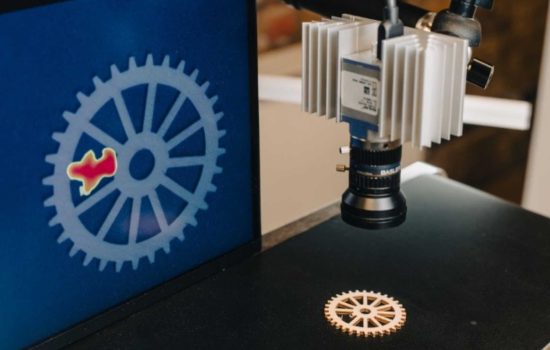
Matta is developing AI systems to enable ‘sentient factories’: production lines able to see, understand and respond to variation in real time. In manufacturing, the hardest test is whether such systems can perform reliably amid the complexity, constraints and variability of the factory floor.
To explore how the gap between promising demonstration and reality can be bridged, Matta Labs hosted ‘Sentient Factories: AI and the Future of Manufacturing’ at the Royal Academy of Engineering.
The event brought together around 80 leaders involved in building, governing and funding the industrial base. Attendees ranged from government ministers and multinational CTOs to start-up founders and engineers with decades of hands-on manufacturing experience.
Speakers included John Lazar, President of the Royal Academy of Engineering; Kanishka Narayan MP, Minister for AI and Online Safety; Tim Minshall, Head of the Institute for Manufacturing at the University of Cambridge; and Douglas Brion, CEO and co-founder of Matta. The event also featured a panel on Manufacturing AI in practice, with contributions from Sophia Martin of 1st Kind, Alan Patterson of BeyondMath, Jerry Gray from Bowers & Wilkins and Steven Grace of Cummins Inc. Several clear themes emerged from the discussion regarding the future of UK manufacturing.
The UK benefits from a powerful combination of world-class artificial intelligence capabilities and a strong heritage in advanced manufacturing. Bringing these strengths together presents a clear opportunity to drive economic growth across the country. While structural barriers remain, including sometimes limited access to patient growth capital for hard-tech companies, ageing infrastructure and high energy costs, these challenges are not insurmountable.
Sebastian Pattinson, Co-founder, Matta
 The UK benefits from a powerful combination of world-class artificial intelligence capabilities and a strong heritage in advanced manufacturing. Bringing these strengths together presents a clear opportunity to drive economic growth across the country. While structural barriers remain, including sometimes limited access to patient growth capital for hard-tech companies, ageing infrastructure and high energy costs, these challenges are not insurmountable.
Start with the problem, not the technology
There is increasing pressure across industry to adopt AI, often driven by the fear of being left behind rather than strategic necessity. However, treating AI as an end in itself remains a mistake. When organisations lack a clearly defined operational problem to solve, deployments invariably struggle. The risk is that these misaligned projects lead to premature disillusionment, causing manufacturers to step back from the technology and miss genuine opportunities where AI could meaningfully optimise the value chain. Technology must serve the problem, not the other way around.
Capturing the knowledge gap
Manufacturing is grappling with acute labour shortages and a looming demographic shift. As experienced engineers retire and skilled vacancies remain unfilled, decades of tacit expertise are at risk of being lost. Industrial AI systems could help address this challenge by capturing the nuanced ways in which experienced engineers evaluate production, systems can dynamically apply that knowledge across a production line. In this way, AI can act as an amplifier for human expertise, preserving operational knowledge and supporting future industrial growth.
When AI meets the factory floor
Unlike software, where errors can often be corrected quickly, manufacturing leaves little room for defects. When heavy machinery, materials, production schedules and safety-critical components are involved, mistakes can have immediate and costly consequences. Overcoming this challenge requires building trust at every level of the organisation, from executives assessing risk to operators relying on the system.
One potential route forward is increased cross-industry collaboration. Enabling non-competing manufacturers to share experiences and demonstrate systems safely in action can provide valuable validation. Seeing AI successfully manage live production challenges is key to bridging the gap between digital promise and physical proof.
The UK’s strategic advantage
The UK benefits from a powerful combination of world-class artificial intelligence capabilities and a strong heritage in advanced manufacturing. Bringing these strengths together presents a clear opportunity to drive economic growth across the country. While structural barriers remain, including sometimes limited access to patient growth capital for hard-tech companies, ageing infrastructure and high energy costs, these challenges are not insurmountable. Developing an ecosystem that supports capital-intensive scaling, backs foundational companies and modernises both digital and physical infrastructure will be essential to translating early technological advantages into long-term global leadership.
The path forward
One of the most encouraging outcomes of the event was a clear willingness to collaborate across the sector. Integrating AI into physical manufacturing cannot be achieved in isolation; it requires sustained dialogue between operators, technology developers and policymakers. With strong interest in maintaining this momentum, further forums such as Sentient Factories are expected to follow.
For more articles like this, visit our Industrial Data & AI channel.