
The JCB Hydromax project has it all; world class, British engineering expertise, cutting edge renewable energy technology, and a record that could stand for years. But
there’s a deeper narrative than a car breaking a land speed record. Through years of engineering, development and investment, JCB is trying to prove that hydrogen is commercially viable, in its own products and on the world’s most demanding engineering stage.
Q&As
- What is JCB Hydromax?: The car has set a world land speed record, but not just that, JCB Hydromax is showcasing hydrogen combustion technology already being deployed in construction equipment.
- How has JCB done this?:The 1,600hp Hydromax race car uses technology derived from JCB’s production hydrogen engines, demonstrating how real-world innovation can be pushed to its limits.
- What is JCB trying to achieve with its product range?: JCB’s ambition is to deliver hydrogen-powered machines that match the power, torque, reliability and refuelling convenience of today’s diesel equipment.
- What is the purpose of the Hydromax project?: The Hydromax project demonstrates how technology developed for everyday construction equipment can be adapted to perform in one of the world’s most demanding engineering environments.
- What does this say about JCB’s ambitions?: Hydromax represents the company’s confidence in hydrogen combustion as a practical, high-performance alternative for the future of heavy equipment.
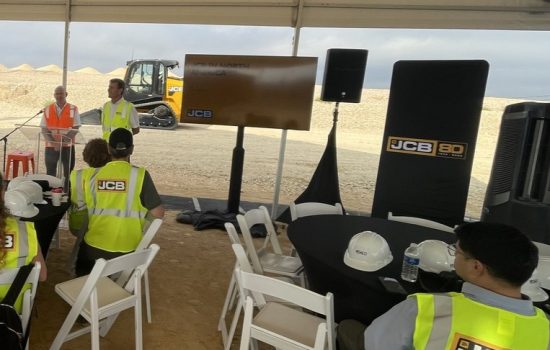
A runway at RAF Wittering was the spot JCB chose for testing. The press were sat at tables within a large tented area, listening to presentations by JCB engineers. A speaker was cut short, when a woman in JCB branded high-vis walked in and announced, “They’re ready”.
We made our way over to a cordoned off viewing point. In the mid-morning drizzle, JCB Hydromax came hurtling down the runway to give the press a photo opportunity. It went reasonably fast and made an impressive sound. But it was clear more testing was needed to get it to record breaking speeds.
This was the one and only time we got to see it in action. Although the day had been arranged for press, we were at the pleasure of the racing team, and indeed, the car itself. This was a live test environment, where things often don’t run smoothly. I’d already been told that the car hadn’t made it onto the test track until 3.00pm the previous day.
“Car seems a slightly odd name for it,” chuckled a well and softly spoken older gentlemen. He was introduced to us as Lord Anthony Bamford, the Chairman of JCB. “That’s its classification though, for a land speed record it needs to be a car.”
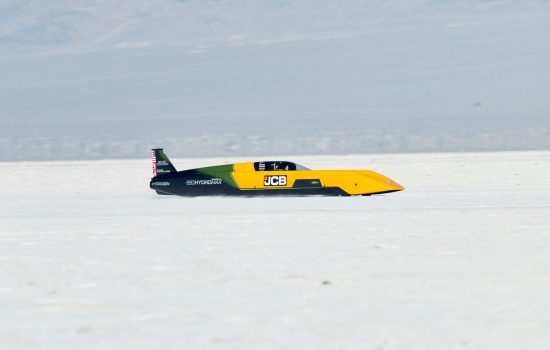
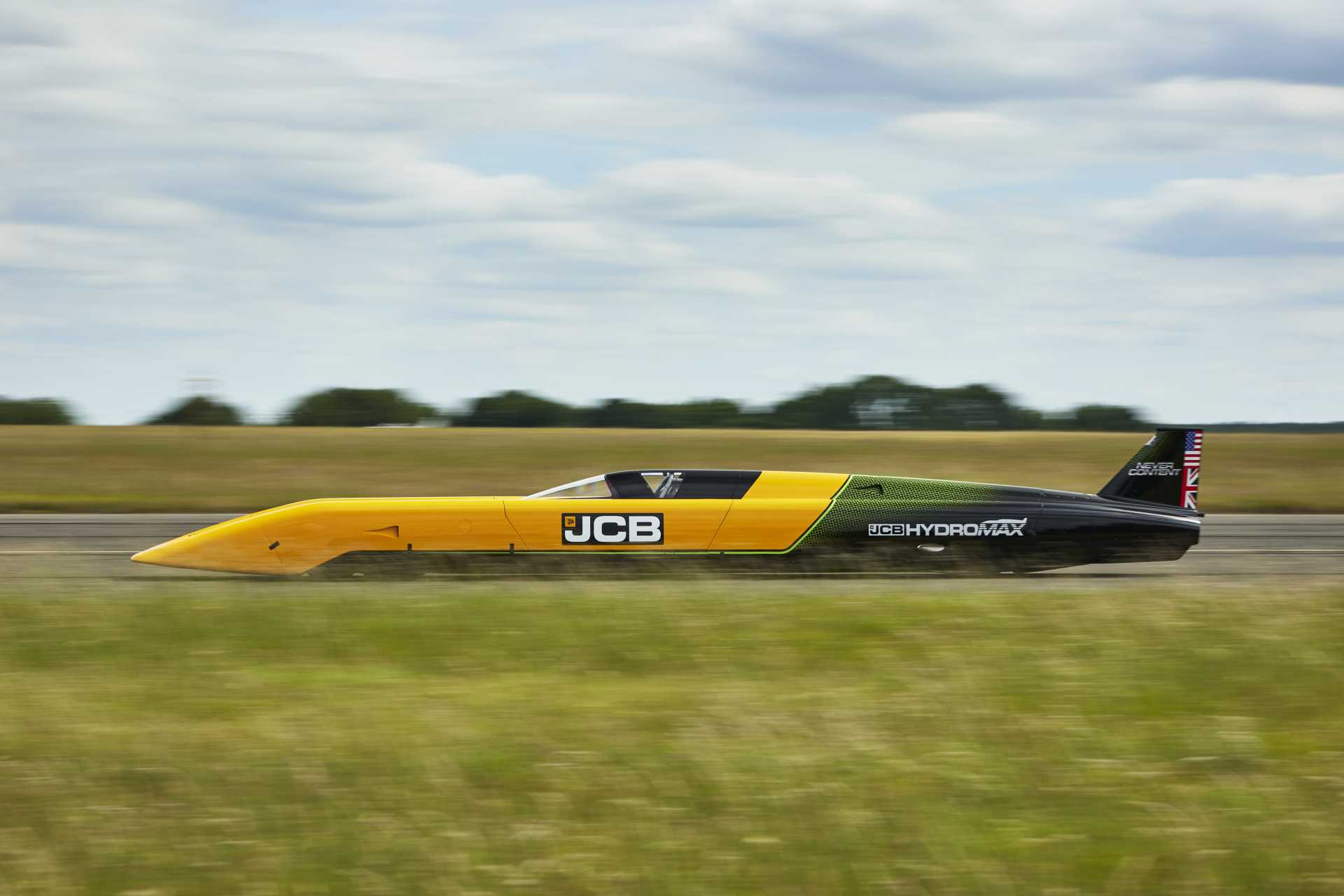
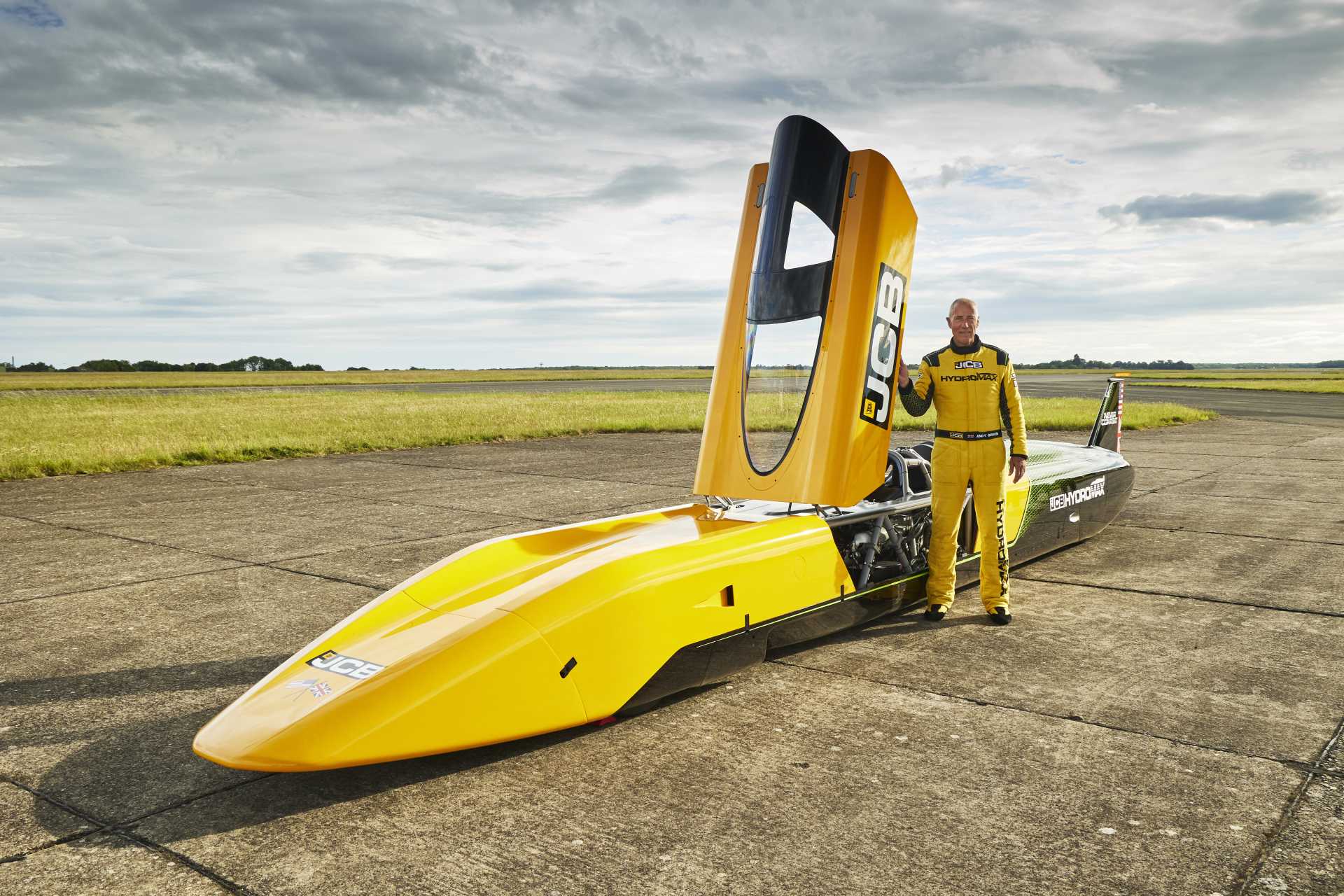
If you’ve seen world record breaking cars like the supersonic Bloodhound and Thrust, and to a lesser extent, the 1935 Bluebird, they look more like planes. The JCB Hydromax is similar – a sleek, 32 foot long, JCB yellow work of art. It’s powered by two hydrogen digger engines, each tuned to an astonishing 800 horsepower. The hydrogen internal combustion engines drive all four wheels through a twin-transmission and clutch system.
The man in the car is Wing Commander Andy Green. “I’ve had the privilege of having the world’s best day job – flying fighter jets for the Royal Air Force,” he said. “And I’ve also got the world’s best holiday job of driving JCB’s new hydrogen-powered land speed record car.”
The attempt was to beat the land speed record for diesel. The all-time record was set by ThrustSSC. Under a team led by Richard Noble OBE, a twin turbofan jet-powered car reached a speed of 763.035mph (1,227.985km/h) – faster than the speed of sound. The man in the car that day was also Andy Green. At this point, he must just feel uncomfortable doing anything slowly.
Beating diesel
JCB is trying to beat its own record. Little did I know that the company has a world-record breaking history. In 2019, the JCB Fastrac was crowned the world’s fastest tractor at 135.191mph (217.568km/h), and in 2014, the JCB GT set the world record for the fastest backhoe loader at 72.58mph (116.806km/h).
And further back, 20 years ago, the JCB Dieselmax set a diesel world land speed record of 350.092mph (563.4184km/h). The man in the car that day was, yep, you guessed it, Andy Green – I can’t imagine he was interested in driving the backhoe loader; he would have barely been breaking the national speed limit!
Building on the 2006 Dieselmax project, the team believes it’s taken drastic steps in engineering prowess. Aerodynamic developments have been studied meticulously and the body of the car has been engineered to cut through the air more efficiently, while also enabling a more stable drive.
So, why hydrogen? The car is powered by the same hydrogen engines that power JCB diggers. To pardon the pun, hydrogen has been the direction of travel at JCB. The company’s Chairman, Lord Bamford, has spearheaded a £100m investment to develop hydrogen-powered internal combustion engines.
“Everybody recognises that there is a problem with global warming,” he said. “If you want to prevent it, there are various solutions. One of the main ones is transitioning away from diesel and petrol fuel.”
He continued: “We know how to make engines and we manufacture 400 diesel engines a day, here and in India. How do we make that engine equally as efficient, but with far less emissions? The way to do that is to power it with hydrogen.”
Sure enough, despite the challenges (which we’ll go into), JCB diggers powered by hydrogen engine technology are now rolling off production lines. Lord Bamford continued: “We’ve now made a few hundred hydrogen engines, and we’ve also sold engines in machines and as generators to end customers – and they are actually using them.”
Convincing a speedster
Wing Commander Andy Green admitted his initial cautious scepticism toward the JCB Hydromax project. As mentioned, he has no problem with going fast, and years on from setting world records in speed he is still hungry for a challenge.
“I’m a pilot by training; aviation has been my life. Aviation and hydrogen have had a chequered history,” he explained. “As most of what I know about hydrogen is 100 years old and involves the Hindenburg, I was still thinking, ‘Are we sure about this?’”
Andy was also concerned about safety, as the driver of any high-speed vehicle should be. Hydrogen atoms’ impact on metal, fuel storage and reliability were at the forefront of his mind.
“I then found myself delving into information a couple of decades old about hydrogen embrittlement, storage and taking the universe’s smallest molecule and trying to keep control of it in a confined space.
“It’s incredibly difficult. It gets out all over the place and presents an unseen explosive hazard because you can’t see a hydrogen flame.” However, those concerns began to fade after JCB engineers explained the extensive work behind the programme. And again, this links to the manufacturing of production vehicles – the company has spent five years developing hydrogen combustion engines.
They’re used in vehicles that are sold to demanding construction sites where they operate safely every day. Andy was reassured: “If it’s builder-proof, it’s indestructible because construction sites are really hard places for technology.” The real turning point for Andy came when he inspected one of JCB’s hydrogen engines that had already completed more than 1,000 hours of testing.
To his amazement, the engine looked almost untouched. “I pulled the dipstick out of the engine and it looked like the oil had just been put in. We pulled out one of the spark plugs, and it looked brand new.”
He explained: “All of the dirt and oil degradation that you see on a regular internal combustion engine spark plug comes from burning chemicals and carbon, which is simply not present in a hydrogen engine. The only chemical the engine burns is hydrogen itself, a process which produces water. Everything still looks the same as the day it was made because the engine runs so clean.”
And with that, a man that has spent most of his life at the helm of jet-powered aircraft and cars, had his revelatory moment. “I suddenly realised why this wasn’t just an affectation of a different kind of fuel. Hydrogen, in the post-carbon era of zero emissions, is quite likely to be the future of the internal combustion engine.”
Making hydrogen work on-site
So, the Hydromax driver was convinced by hydrogen but the bigger challenge has been at a business level. JCB customers needed to be confident also. And indeed, JCB engineers needed to assure themselves, having spent many hours assessing and testing hydrogen as a viable option.
It was made clear to the press in attendance at RAF Wittering, that the transition from diesel to hydrogen has been a challenge for the business. Significant research, as well as engineering trial and error, has gone into fuel cell production and engine development. As Cameron Scott, a Senior Engineer at JCB pointed out, it’s never been about following one technological path, but rather, finding the right solution for the right machine.
“To be honest, we’ve tried a bit of everything,” he said. “We’re now an 80 year old business and we’ve been involved with diesel for quite a while. We also produced the world’s first electric mini excavator, the 19C-1E, which works really well. It has its own niches as a product.”
However, battery electric becomes more challenging to scale for larger equipment with higher energy demands. From there came the investigation into hydrogen fuel cells, developing prototype 20-tonne excavators powered by the technology. Although the concept delivered zero tailpipe emissions, engineers concluded it wasn’t the right solution for the harsh realities of construction sites.
The cost of producing green hydrogen using renewable energy sources was also proving impractical. Hydrogen production vehicles are more expensive to produce than their diesel counterparts. An explicit instruction from Lord Bamford was to ensure any new hydrogen machines were not an inflationary product for customers.
Cameron continued: “It would have cost over three times the price of a diesel machine to productionise, which we thought was astronomically expensive.
“There were lots of durability concerns as well. We found that fuel cells didn’t really like dirt, dust and vibration – factors that tend to be quite prevalent on an excavator.” But that didn’t stop JCB and the company continued to persist with hydrogen.
So, the focus moved from fuel cells to a technology that the company already understood better than most manufacturers – internal combustion engines. “We make our own diesel engines,” said Cameron. “So, it was a case of developing a new engine technology that became the engine we have today – a 55-kilowatt, four-cylinder internal combustion engine, with the only emission being steam.”
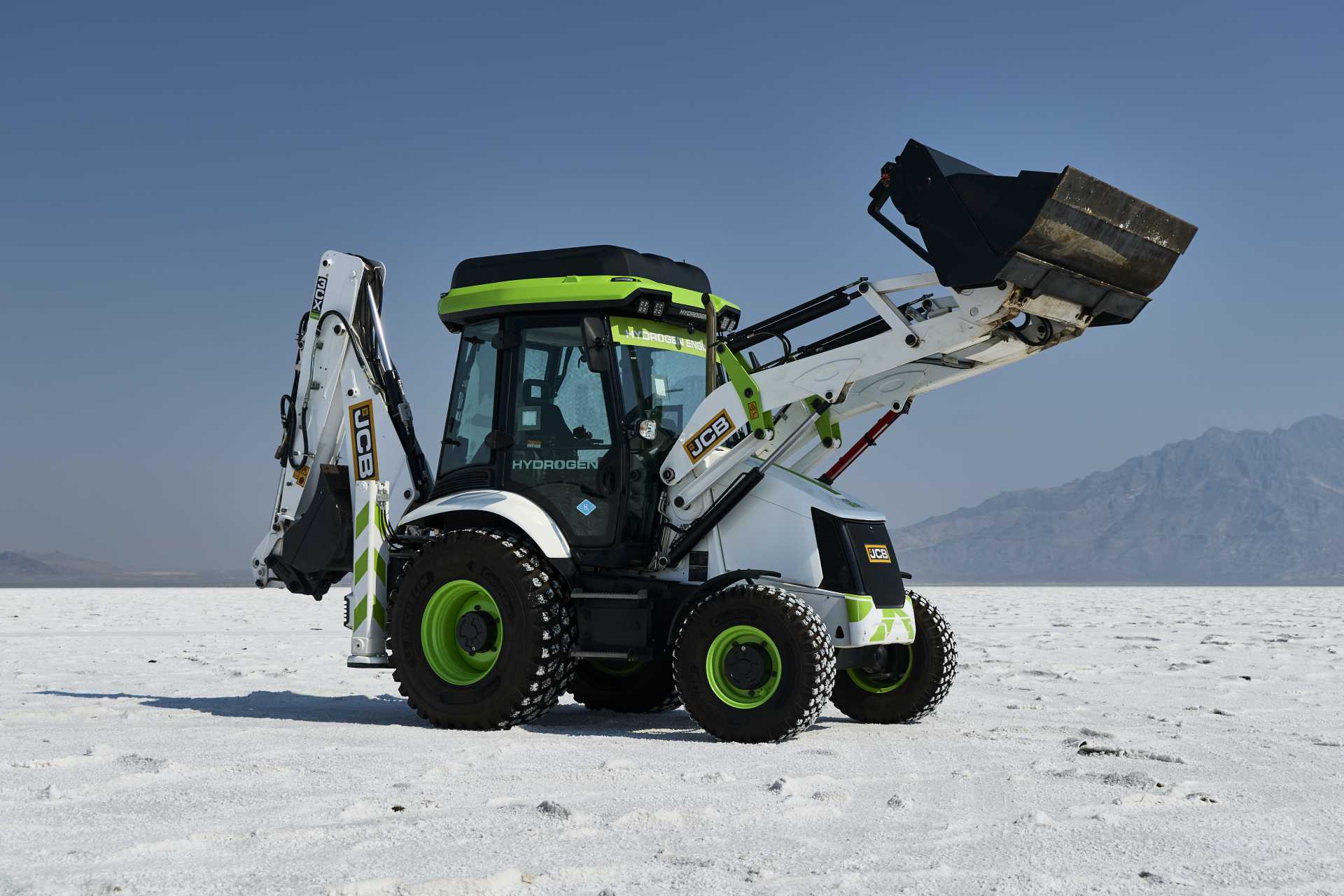
To mitigate cost, the machines and engine models are based as closely as possible to existing diesel products. “This means we can build them on the same production lines with the same personnel,” said Cameron. “And by using the same suppliers as much as possible, we’re getting the cost control that we want.”
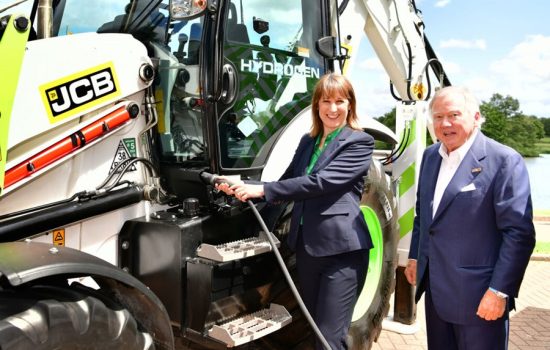
Another challenge to overcome was the current infrastructure for hydrogen refuelling, with limited stations available globally. As such, JCB has developed a mobile hydrogen refuelling unit which stores hydrogen in cylinders and can be towed on public roads before refuelling machines on-site, in much the same way as conventional diesel bowsers.
“It can fill up a machine in around 10 to 15 minutes,” said Cameron. “Then you get a full day’s work out of the machine before it needs topping up again.” The ability to refuel quickly while maintaining a full day’s operation is one of hydrogen’s biggest advantages, according to Cameron. “Hydrogen definitely has a place, particularly for lager equipment that needs mobile, flexible fuel. Batteries simply don’t cut it.”
He continued: “This is one of the few examples of where we actually want our competitors to do the same as us. When we started this programme there were only a handful of hydrogen internal combustion projects, and now there are hundreds. We see a vast growing interest in the technology.”
350mph digger engines
The industrial product transition and the JCB Hydromax land speed record programme are seen as part of the same journey. And as mentioned, the car shares fundamental technology with the hydrogen machines being developed for customers, demonstrating that the innovations being pushed to their limits to attempt a world record have relevance to equipment operating on construction sites around the world.
Cameron beamed, standing in front of one of JCB’s hydrogen diggers: “It’s fantastic to see the parallels between the machine behind me and JCB Hydromax. The fuel system is the same on both vehicles. It has the same base engine which has obviously been fine-tuned to get the speed that we want; there are a lot of parallels.”
JCB Hydromax is pushing hydrogen power to its absolute limit. While the production hydrogen engine produces 55kW (74hp), each race engine has been re-engineered to produce an astonishing 800 horsepower – more than ten times its standard output. Mark Richards, a Principal Engineer at JCB was standing next to one of the bright green production engines.
“74 horsepower is great for an on-site machine, but you need a lot more power to get up to that 350mph mark.” Achieving that increase has required significant engineering changes while preserving the engine’s fundamental architecture.
Mark explained: “The engine speed has doubled from around 2,200rpm to almost 4,500rpm, prompting the move from a traditional pushrod valvetrain to a twin overhead camshaft design for greater control at high speed.”
Hydrogen delivery has also been completely redesigned. “This engine here is what’s called a port fuel injected engine,” said Mark, pointing to and moving around the engine. “With the Hydromax race engine we’ve gone for direct injection. That means we can rapidly get a lot more fuel into the combustion chamber, so we effectively get a larger bang. We make more power from the same engine displacement.”
The engineering team has also reduced weight throughout the engine, introduced water injection to improve combustion, adopted dry sump lubrication borrowed from endurance racing, and increased oil and coolant flow to cope with the significantly higher power output. Despite those changes, Mark was particularly proud to point out that one of the engine’s most important components remains largely untouched.
“The crankshaft actually remains almost exactly the same as our production engine – the same as we did with Dieselmax 20 years ago – to showcase that the engine can get to those power levels, but remain largely unchanged in terms of its DNA.”
Mission accomplished
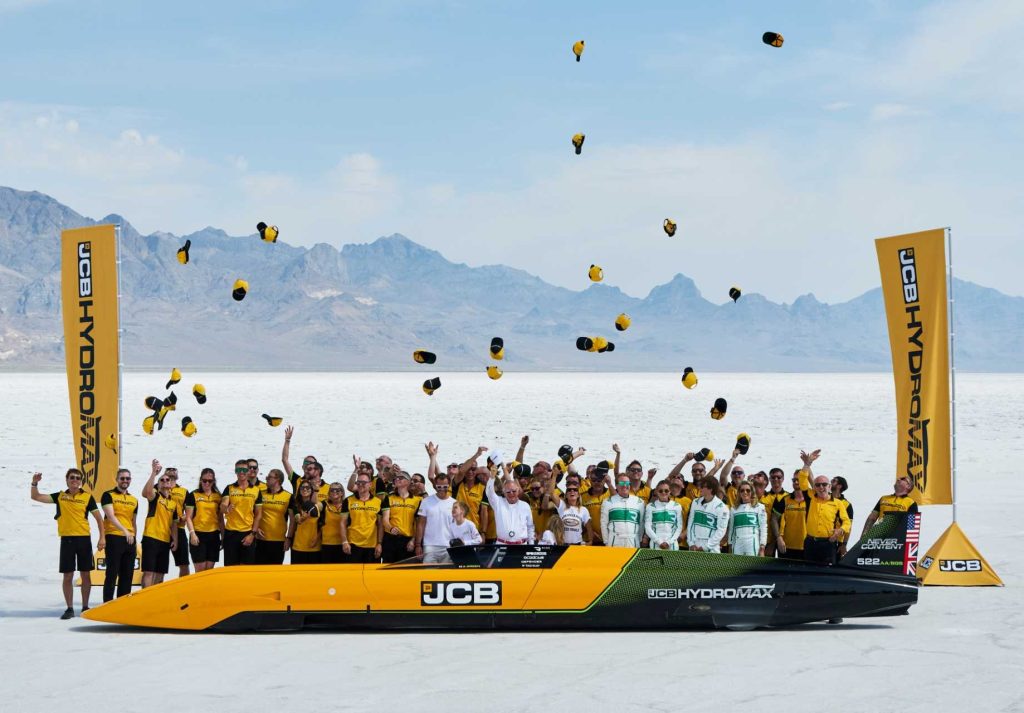
The final test for JCB Hydromax came at Bonneville Speed Week on 1–7 August. JCB returned to the famous Salt Flats in Utah, where Dieselmax set the diesel land speed record with Andy Green at the wheel 20 years ago.
The record-breaking attempt came ahead of the opening of JCB’s new $500m, one million sq. ft, 400-acre factory in San Antonio, Texas, which will employ 1,500 people, manufacturing machines for the US market. Again, demonstrating how linked the Hydromax project is to wider company strategy.
The car ran on the Salt Flats at 8:05am on 6 August, and reached a top speed of 368.347mph (592.797km/h) to set a new world record.

The on 11 August, it went even faster – recording an average speed 400.623mph (644.740km/h) in its first run and 412.135mph (663.266km/h) on its second run, giving the average of 406.320mph.
Andy and the team were unsurprisingly delighted: “This record has given all of us huge confidence in the car, the team and the quality of the engineering. He’s travelled faster than this of course, almost twice as fast in fact – he’s the only person alive to have broken the sound barrier on land.
But he gave the impression that this is something bigger than another world record. “This is not about race car production and advertising. This is about advertising the technology,” he said. “We’re going to showcase Great British engineering on a global stage, and help to promote, and make people think about, the zero-carbon alternative for the internal combustion engine of the future. “That is incredibly exciting, and I’m very proud to be part of this team.”
Read more stories from The Manufacturer