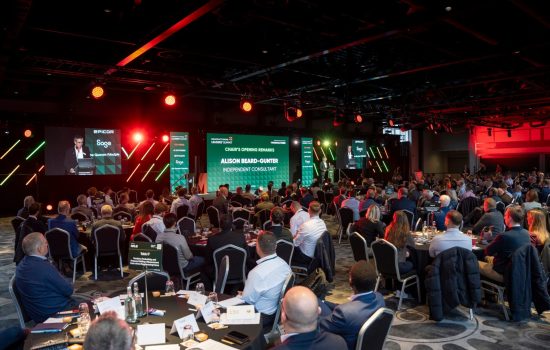
UK manufacturing is facing a difficult landscape and the question is no longer whether the sector needs to change, it’s how to make the right ones, in the right order. Now in its 18th year, Manufacturing Leaders’ Summit , which returned to the Titanic Hotel Liverpool on 10-11 November, is the annual gathering of the industrial elite. Leaders, senior executives and decision-makers representing all industries across the manufacturing sector converge with thought leaders and industrial futurists for two days of knowledge-sharing, debate and discussion that shapes the industry for the coming 12 months.
The landscape for manufacturers, while challenging, is also shifting. 2026 has seen the conversation around digital technologies and transformation take a definite and identifying pivot from exploration to deployment and expectation. As such, the award-winning summit has been redesigned to to reflect the realities of operating in a high-cost, high-pressure and increasingly uncertain environment, with the conversation having evolved from mere programmes and pilots to the business outcomes they are expected to deliver.
Introducing the summit, Henry Anson, Director at The Manufacturer commented on the collaborative nature of the event, which is an occasion where the best in the industry comes together.
He said: “This occasion is about leaning in, sharing knowledge, war stories and triumphs, and leaving with takeaways that you can do differently.”
Keynote: Digital maturity to digital agility
Kicking off day one, Asif Moghal, Director at Autodesk, highlighted that manufacturers have pursued digital maturity for quite some time, but posed the question: what if maturity is no longer the right destination? In a world of accelerating AI, shifting competition, and continuous disruption, the greater advantage may be digital agility: the ability to turn change into industrial advantage, repeatedly.
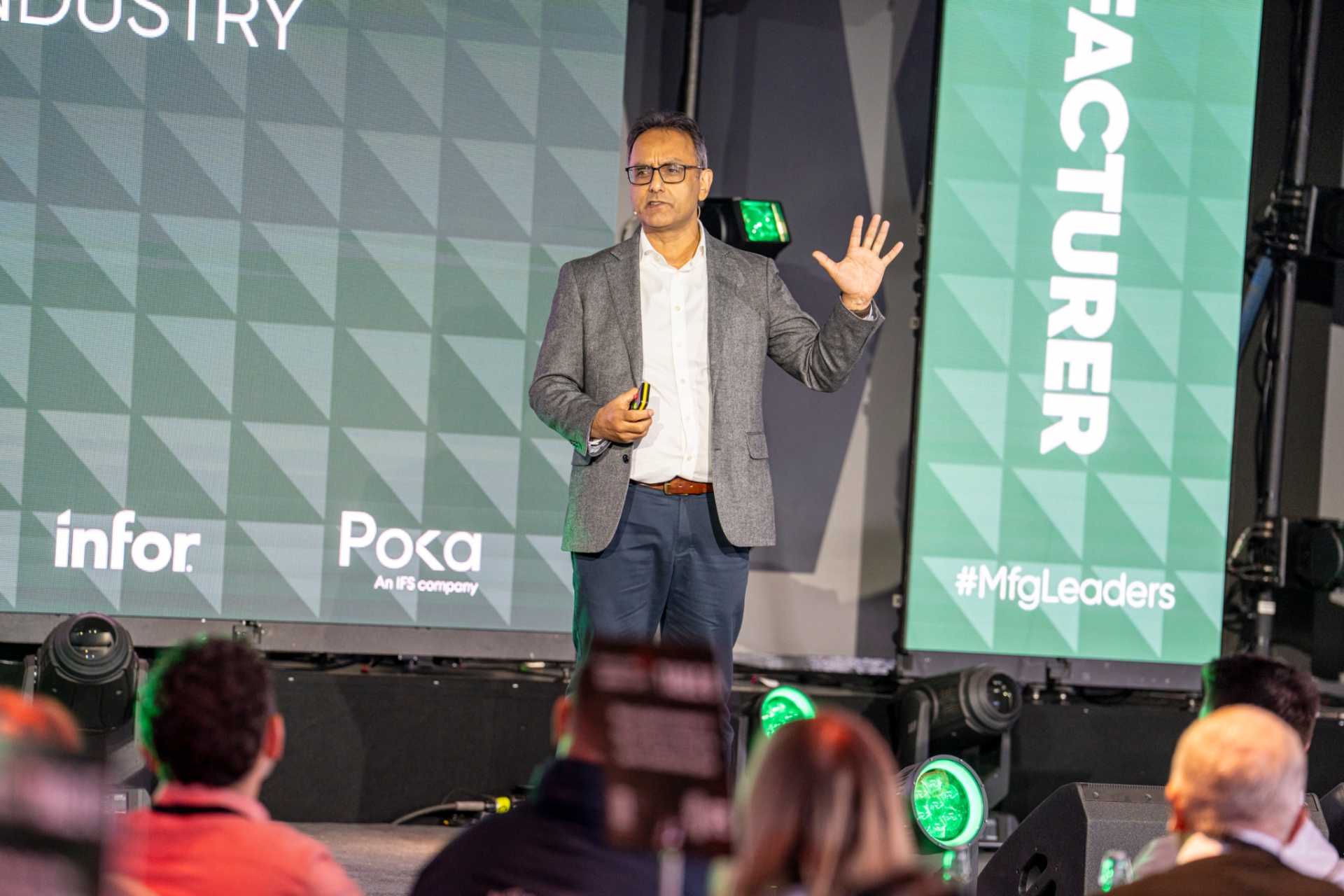
The keynote challenged manufacturers to rethink their approach to digital transformation, arguing that digital agility is now more important than digital maturity in an increasingly unpredictable world.
Drawing on conversations with businesses across different industries and levels of digital maturity, three key shifts emerged:
1. Operational adaptability over technology mastery: Businesses must become better at identifying, evaluating and adopting new technologies, particularly AI, faster than their competitors.
2. Whole-system responsiveness over individual productivity: Rather than focusing on how many employees use AI tools, organisations should empower cross-functional teams to collaborate, validate ideas and solve problems across the entire business.
3. Human judgement over blind trust in technology: AI can generate ideas, analyse information and provide evidence, but people bring the experience, curiosity and judgement needed to turn technological capabilities into meaningful business outcomes.
The keynote introduced four pillars of digital agility: Connect, Decide, Adapt and Learn. Together, these create shorter learning cycles, helping businesses respond to change, improve decision-making and continuously develop.
The central message was clear: successful digital transformation doesn’t start with technology. It starts with understanding business outcomes, empowering people and bringing the right teams together.
Ultimately, the businesses that succeed won’t necessarily be those adopting the most technology, but those empowering their people to use it most effectively.
In a world where it costs us nothing to generate answers, the value of the questions we ask, and the experience and judgement we apply, becomes priceless…
The most successful companies won’t necessarily be the ones that have adopted the most technology, but the ones that have empowered their people to use technology in a very agile way.
Keynote: Precious elements in dormant data – using AI to create new value from data we already hold
Manufacturers hold years of valuable R&D and operational data that is rarely used to its full potential. AI now makes it fast and affordable to structure and connect that knowledge, which makes high-value data products practical. Illustrated by a live Johnson Matthey project, Razvan Popescu explored why the opportunity is open now, where the outsized benefits lie and how manufacturers can build data products from what they already know.

His keynote explored how manufacturers can use AI to unlock decades of valuable historical R&D data, transforming previously inaccessible information into a competitive advantage.
Using Johnson Matthey as an example, Razvan highlighted how manufacturers accumulate enormous amounts of experimental data, including unsuccessful tests, old formulations, laboratory notebooks and research records. Much of this knowledge remains trapped in inconsistent formats, spreadsheets, paper records and individual hard drives, making it difficult to access or reuse.
AI now offers an opportunity to extract, structure and interpret this information at scale, potentially replacing years of manual data entry and digitisation. However, successful implementation requires expert knowledge, clear rules, structured data, quality validation and human oversight.
The keynote identified five major opportunities: finding historical experiments faster, avoiding repeated testing costs, predicting outcomes through machine learning, creating differentiated customer value and developing entirely new products and markets.
The biggest takeaway was to look beyond efficiency and focus on growth.
Manufacturers have already invested in decades of research. AI provides a new way to turn that accumulated knowledge into innovation, new revenue streams and competitive advantage.
Your competitors can buy the AI. Everyone has access to it. But no one can buy your history…
The magic happens when you move beyond efficiency towards prediction, differentiation and creating higher value for your customers.
Keynote: AI is a data strategy you never finished
In his keynote, Infor‘s VP UK&I Sales, Mark Hughes, drew the audiences attention to the fact that eight in ten business leaders say they’re ready for AI, yet half are still stuck in pilots. Mark stressed that models aren’t the problem. The challenge is the data underneath them. Drawing on new Infor research of 1,000 decisionmakers, he explored why many manufacturers aren’t struggling with AI itself, but with the foundations needed to make it work at scale.

He explored why, despite widespread enthusiasm for AI, many manufacturers are still struggling to move beyond pilot projects and achieve measurable returns on investment.
The central message was that AI isn’t failing; it’s being held back by poor data, processes and people. Without accurate, reliable business data, manufacturers cannot expect AI to deliver trustworthy insights or make effective decisions.
The speaker highlighted five major challenges facing manufacturers: proving ROI, scaling AI initiatives, data sovereignty, talent shortages and ensuring AI understands their specific industry.
A key point was that generic AI tools such as Copilot and Gemini can improve individual productivity, but they don’t necessarily create meaningful business value. Real value comes when AI understands three things: the industry, the individual business and the specific problem being solved.
The keynote also emphasised the importance of human involvement, explaining that successful AI adoption requires employees to embrace the technology and remain part of the decision-making process.
The speaker concluded with a practical five-step approach:
-
Identify one specific business challenge
-
Get the data right
-
Bring people on board
-
Establish effective processes
-
Measure results through clear ROI
The takeaway: Get the data right, finalise the processes and get the people right – then AI becomes the easy part.
You can only make good business decisions and enable AI to do things for you when the data is correct…
AI can only add real value if it understands the industry you’re in, knows your company and the business problem you’re trying to solve.
Panel: Is UK manufacturing truly ready for AI at scale – or are we still performing pilots?
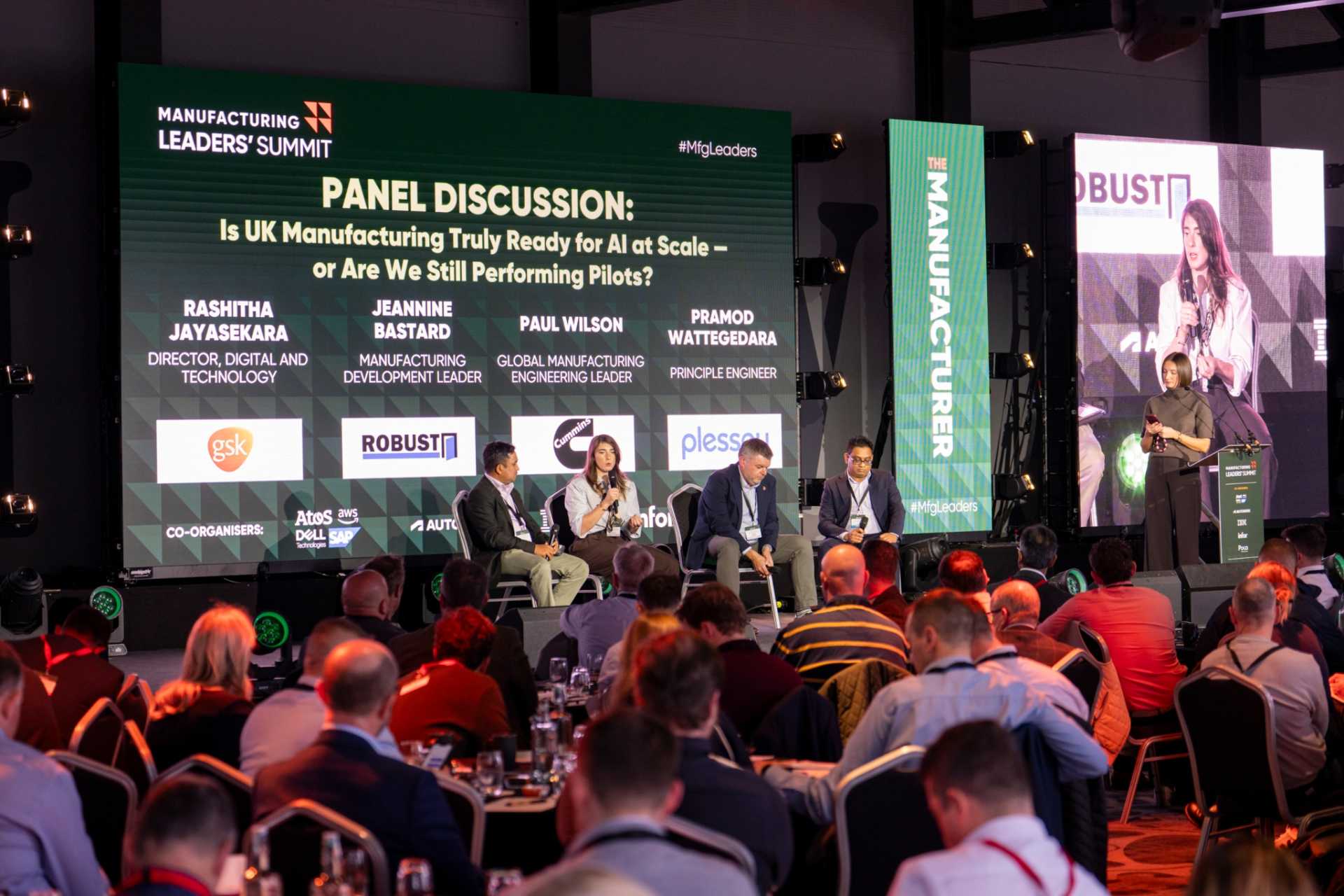
Following the morning’s keynote, GSK‘s Rash Jayasekara, Jeannine Bastard of Robust UK, Cummins‘ Paul Wilson and Pramod Wattegedara of Plessey Semiconductors discussed the level of AI ambition across the industry, but asked how many manufacturers have genuinely operationalised it beyond isolated use cases?
The panel concluded that UK manufacturing is making progress with AI, but widespread industrial adoption remains at an early stage. While AI has significantly improved personal productivity, administration, planning and data analysis, many industrial applications are still at the pilot and experimentation stage. Moving successful trials into reliable, real-time production remains the biggest challenge.
A recurring theme was the importance of high-quality, contextualised data. Manufacturers must address data silos, legacy systems, ownership, accessibility and cyber security before AI can deliver meaningful operational value. Data alone is insufficient; organisations also need clear accountability for turning AI-generated insights into business decisions.
Workforce engagement and upskilling were equally important. Rather than simply recruiting AI specialists, manufacturers should combine technical capabilities with existing operational expertise. AI offers an opportunity to capture experienced employees’ knowledge, support training, improve collaboration and reduce knowledge gaps across organisations.
The panel also stressed the need to move beyond AI hype and focus on measurable business outcomes. Manufacturers should start with targeted, high-value applications, build trust through accuracy and demonstrate tangible benefits before scaling.
Ultimately, successful adoption requires leadership commitment, collaboration, strong governance and the authority to change established ways of working. The challenge is no longer experimenting with AI, but embedding it into everyday manufacturing operations.
Keynote: The intelligent enterprise – connecting data, people and operations
Simon Tilley, EMEA Process Industries Lead, IBM Confluent claimed that an Intelligent Enterprise is the prerequisite to the Autonomous Enterprise. He offered his experience of delivering the company’s Digital Bloodstream that connects operational and information technology, supply chains and people to deliver substantial improvements in OEE and productivity as well resilience and quality, as well as inventory and risk – all whilst accelerating the pace of change.

The keynote explored why manufacturers must move from discrete, transactional business operations towards continuous, real-time operations to unlock the full potential of AI.
Using the analogy of a kung fu master, Simon described an effective business as fluid, dynamic and responsive, constantly adapting to changing customer demand, operational conditions and market requirements.
Examples from BMW, Siemens Healthineers and other major manufacturers demonstrated how real-time data streaming can connect customer interactions, manufacturing, distribution and supply chains. This enables businesses to anticipate demand, optimise production, predict equipment failures and respond more quickly to changing conditions.
A central message was that data is like light: it enables organisations to see and understand what is happening across their business. However, traditional systems often rely on disconnected platforms and complex point-to-point integrations, creating barriers to visibility, innovation and change.
The speaker identified four priorities: building architectures that maximise data utilisation, enabling AI and automation at scale, accelerating business change, and reducing the energy and computing costs associated with AI.
Customer examples highlighted significant benefits, including reduced data latency, fewer integrations, faster delivery of business solutions and lower computing costs.
Ultimately, manufacturers need a simplified, connected digital infrastructure that allows data to flow freely, supporting continuous operations and scalable, cost-effective AI adoption.
Data is like light. It’s the medium through which you have the opportunity to really see and understand what’s happening in the world.
AI is really expensive. It’s incredibly computationally intensive. If we start just doing it willy-nilly everywhere, its use is going to become prohibitively expensive.
Keynote: From demand to delivery – building an additive manufacturing capability for the future
As demand grows for more agile, resilient and sovereign supply chains, James Bye, Additive Manufacturing Lead at Babcock International, explained how companies can evolve additive manufacturing from a fringe manufacturing method to a critical defence and industrial capability.
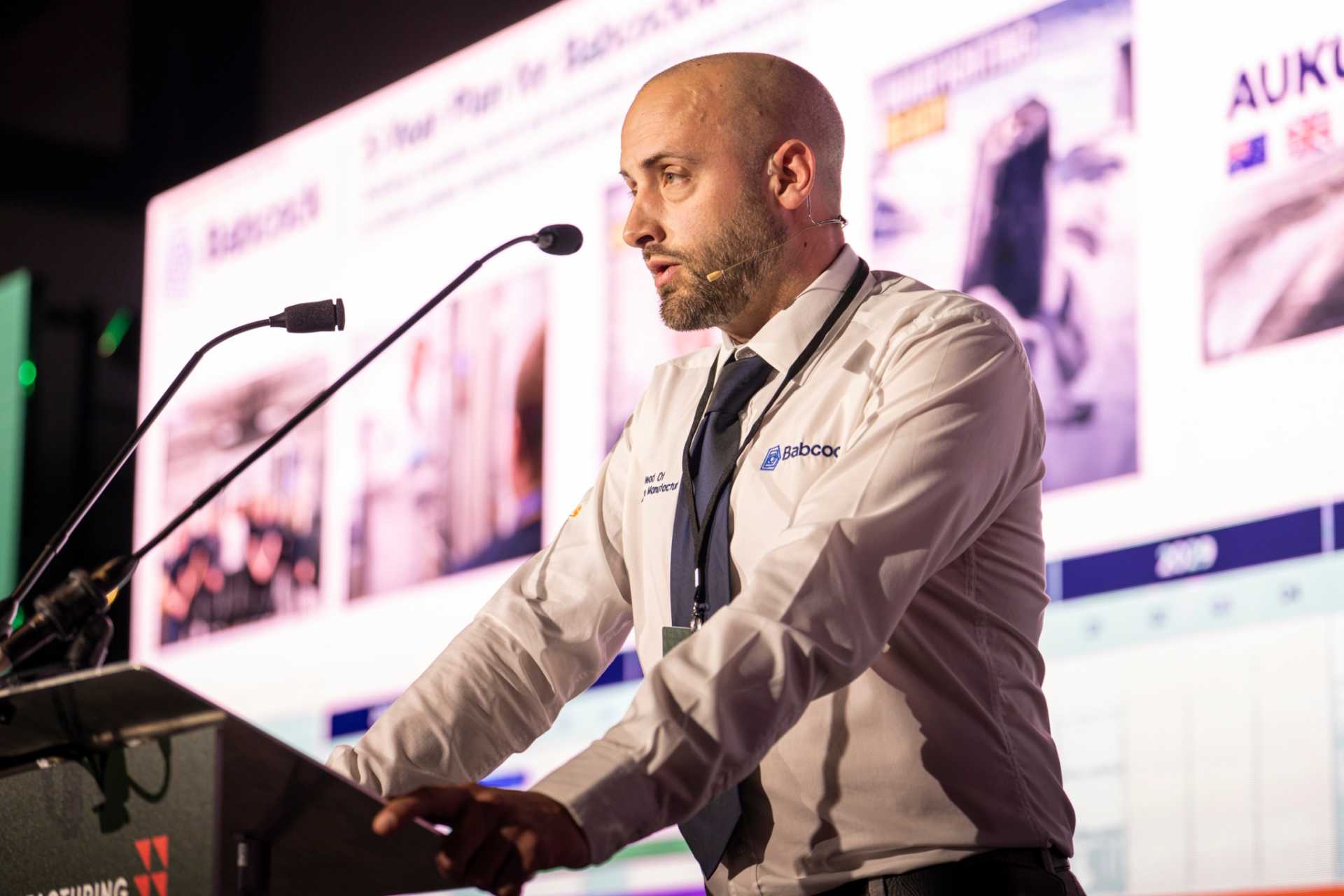
The presentation explored how Babcock is building a global additive manufacturing capability to reduce obsolescence and supply chain constraints, accelerate asset availability, and strengthen operational resilience across defence platforms. Babcock will be sharing lessons learned for future gain in what is a highly regulated and mission-critical environment.
The keynote also looked at how Babcock is developing a national additive manufacturing capability to strengthen UK defence supply chains, improve asset availability and support critical infrastructure.
Rather than simply investing in 3D printing technology, Babcock’s ambition is to transform how it manufactures and supports critical assets. It has moved from initial research and experimentation to establishing an 18-person specialist team covering engineering, metallurgy, digital technology, quality, supply chain and commercial delivery.
A major driver is tackling obsolescence, long lead times and procurement challenges. Babcock identified approximately 8,000 components affected by extended lead times and 16,500 parts on obsolescence registers. Additive manufacturing offers opportunities to reverse-engineer obsolete components, manufacture parts on demand and reduce reliance on traditional supply chains.
The speaker emphasised the importance of developing a digital thread connecting design, materials, manufacturing parameters, inspection and certification to ensure traceability and quality in a highly regulated environment.
Key lessons included starting with operational challenges rather than technology, embedding quality and certification from the outset, collaborating across industry and investing in skills.
Ultimately, success will be measured by improved availability, supply chain resilience and customer value, rather than the number of components printed.
Success won’t be measured in how many machines we operate or how many components we print. It will be measured in the problems we solve, the resilience we create for our customers and how we improve availability and value
For further information on Manufacturing Leaders’ Summit visit the event website.